

The judgement of beauty orders the emotions and the desires of those who make it. It may express their pleasure and their taste: but it is pleasure in what they value and taste for their true ideals.
Beauty can be consoling, disturbing, sacred, profane; it can be exhilarating, appealing, inspiring, chilling. It can affect us in an unlimited variety of ways. Yet it is never viewed with indifference: beauty demands to be noticed; it speaks to us directly like the voice of an intimate friend. If they’re people indifferent to beauty, then it is surely because they do not perceive it.
Beauty encompasses a vast set of meanings, definitions, and applications. That Roger Scruton wrote a succinct book on beauty and that he encompasses beauty’s vast set of meanings, definitions, and applications with clarity, wisdom, and does so beautifully, is extraordinary. Beauty: A Very Short Introduction is a philosophical masterpiece. Scruton analyzes, defines, and argues the concepts of beauty—from taste, fashion, and sexual desire to music, judgment, nature, art, architecture, spirituality, film, and the desecration of beauty. It is an enlightening work that at one end provides wisdom and perspective on the various forms of beauty and one’s taste for it, and at the other provides enjoyment in the beauty that surrounds us, whether it is a beautiful smile, the view from a window, or a piece of art.
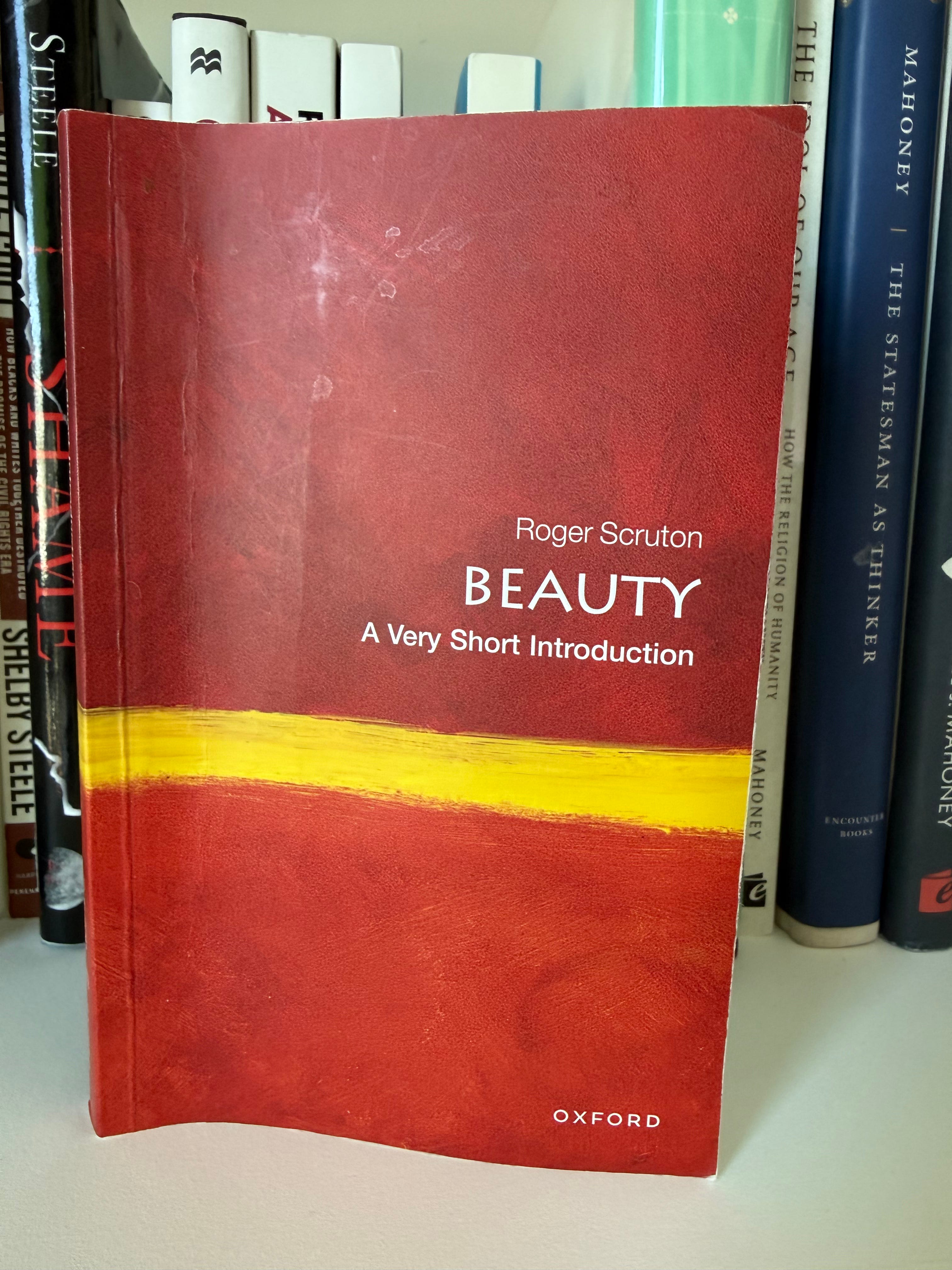
Background on Scruton
Roger Scruton is a famous conservative intellectual. Though, to the very online, “conservative” is a pejorative for no good reason other than dorkish purity signaling. Still, to avoid casting him into the same pot as Mitt Romney for the reflexive reader, Roger Scruton is a prominent right-wing intellectual. He is a near polymath with the breadth of his thought—from political philosophy to theology to the philosophy of art and, with this book, the philosophy of beauty. While he is an intellectual, he has a gift for making his arguments accessible. He has a way of unlocking depth whether he is excoriating the New Left or simply defining what’s behind our senses when we observe beautiful green stretches of farmland in Nebraska.
What Is Beauty
Beauty is not subjective. Yes, beauty is in the eye of the beholder; that eye comprises taste and that person’s ideals. But beauty is not subjective. The true and the good exist in beauty. Beauty is both physical and metaphysical. Beautiful people exist just as beautiful art exists, and either can emanate impressions. A woman can have a sensual grace about her that adds to her physical beauty, as a man can have intellectual depth that adds to his rugged good looks. A Winslow Homer watercolor can elicit sentiments of the environment, whereas the intense realism and masterful detail of a Flemish painting make the painting alive. We can stand on a beach and watch a sunset, or in a Midwestern field on a late-summer afternoon, and either stirs something in us, just as we are stirred when we face the sublime of large snowcapped mountains. What all that does to us and to others is objective. Absolute judgment of it exists, and judgments can wade into the abstract. But a person’s taste, depth, and disposition move the abstract closer to an absolute truth. A simplistic example: the beauty of Mozart is universal. But when Yoko Ono howled gratingly into the microphone during Chuck Berry and John Lennon’s live performance on television, we know that as ugly.1
We also know a beautiful landscape can be accentuated by buildings or desecrated by formulaic commercial buildings. The latter is perhaps best—and hilariously—shown by the parody account Mason Home Builder:

Beauty is objective. Beauty comes in many forms, as does its opposite, ugliness. Our perception of beauty is taste. We each have personal tastes. Our taste is a result of our disposition and education (education in the broad sense of life experience, intellectual depth, culture, and so forth). Taste wades into the abstract, and disagreements—strong ones—can arise. I will share my strong disagreement with Scruton below. But on the whole our taste, innate and learned, shapes not merely individual preferences but culture.
Implicit in our sense of beauty is the thought of community—of agreement in judgments that makes social life possible and worthwhile.
Healthy, well-adjusted people recognize beauty without needing a PhD from a university to explain it to them. The sublime expanse of the Grand Canyon stops people when they see it; it moves and stirs them. Certain paintings have that effect as well. You yourself may have been to a museum, stopped in front of a piece, and time slipped away as the piece stirred something within you. Our education, our level of curiosity, can add depth to our taste. We may not be an expert in, say, Impressionism, but we can look at a Renoir or a Van Gogh, and the sensuousness the painting captures or the live feeling it depicts sharpens our enjoyment, understanding, and taste. For instance, why do we detect a “sensuousness” in a field and all the emotions, sentiments, and impressions from a particular Renoir? In other words, education helps inject vocabulary to articulate the feeling. This recognition goes beyond art. We recognize beauty in people too. People of depth recognize both the metaphysical and the physical in a person. The metaphysical consists of the qualities, traits, and dispositional factors. The physical can be the distinct features of the person, most obviously attractiveness or sexual desirability, which then wades into The Eros—a person’s sexual expression and the desires from the primal, emotional, and cerebral. This sexual desire can be expressed via a painting or even how you or your date dresses for a night out.
Scruton argues how a culture and its individuals can contribute to the beautiful by building, exemplifying, or working toward a society aimed at the good and the true, and how the beautiful affects people. The beautiful can educate our tastes, provide a moral incentive that weakens our impulse toward vice, and create a form of harmony. For instance, a beautiful park in a city surrounded by tasteful, beautiful, and—perhaps most important—vernacular buildings (meaning it pays heed to the past and the culture rather than rejecting it all, while maintaining a modern sensibility) enhances the pleasantness and usefulness of the space. In architecture, modernists became obsessed with rejecting the vernacular. One sees this in the generic, homogenized glass skyscrapers that reject the vernacular of the city, lifeless strip malls, or homogenized business parks.
Turning to fashion, Scruton details how the way we present ourselves to the world and for specific situations speaks of our ideals and personality. For instance, a man and woman dressing up for an intimate date at an upscale restaurant will choose different styles depending on location. Women have greater capacity for this form of expression. A sexy date in Las Vegas will have a different fashion approach for a woman than a tasting-menu dinner at an inn on the coast of Maine. But how we dress for each expresses ourselves, our ideals, our intentions, and our cultural sensibilities. Our sensibilities, personal and vernacular, we inherit and pass on, yet culture informs these sensibilities. Transgression is now common, along with a lack of development of sensibilities. Going back to our date example, what might work in Las Vegas might be transgressive at the inn in Maine, just as the opposite looks stiff. In other words, dressing performatively modest is attention-seeking, as is dressing overtly transgressive.
Cultural Relativism: The Moderns Destroying Beauty
More recent art cultivates a posture of transgression, matching the ugliness of the things it portrays with an ugliness of its own. Beauty is downgraded as something too sweet, too escapist and too far from the realities to deserve our undeceived attention. Qualities that previously denoted aesthetic failure are now cited as marks of success; while the pursuit of beauty is often regarded as a retreat from the real task of artistic creation, which is to challenge comforting illusions and show life as it is.
The antithesis of beauty is everywhere, from how we dress to activist paintings, novels, music, and the landscape you see walking down your street. A postmodernist conviction exists: art must be transgressive. Beauty must reject tradition or norms. Anything inherited from the past is a pastiche, and art instead must contain a message, an activist symbol, or denigrate tradition. This belief derives from a modernist theory that traditional art was becoming tired, a pastiche, or Christian propaganda to stifle the masses and the artist.
A famous example of this “art must be transgressive” imperative is Andres Serrano’s Piss Christ.

This transgressiveness, which often gives people an identity, imbued itself into the fiber of modernity. It lowers the bar and the standard. One need look no further than the sloppy dress—athleisure, sweats, pajamas, adult men in comic-book T-shirts—donned in airports. Not that athleisure cannot look good (women often pull it off better than men), but athleisure is often a form of pajamas. We see athleisure pants on overweight men with untamed beards while they wear Marvel Comics T-shirts. Modern songs have become wholly homogenized; fewer words and instruments are used, and the analog experience is denigrated. Even in education, standards are lowered, tech is deified at the cost of teaching young minds to conceptualize an answer—whether it is a math problem or grasping Gulliver’s Travels. Anything not “activist” or a push for testing efficiency is seen as right-wing, dangerous, or outdated.
Functionality, or utilitarianism mixed with materialism, optimization at any cost, and even forms of transhumanism, are hailed as better replacements for the beautiful. Instead of reading as an end in itself, we must treat reading as a means for personal purposes: 10x income, become a better leader, remove your white privilege, and so on. Or all strip malls must feature lifeless, homogenized, functional looks in the name of efficiency. Inevitably, those modern strip malls will be knocked down and rebuilt again, since they lack beauty, lack meaning, and in the end lack long-term functionality.
A great example of the rejection of beauty is at the Denver Art Museum’s fourth-floor exhibition. It features modern art that is all activist. From a brown tattered blanket tacked up on the wall (its tatters and color represent America’s racism and oppression of Black and Brown people) to the most egregious of the too-on-the-nose paintings in the Kent Monkman exhibit.2 Monkman takes traditional painting elements to then create all Indigenous people as trans or queer (always men) and as dominating white traditional males who always happen to have erections, seemingly turned on by the queer Indian chief, unable to hide their attraction despite getting shot full of arrows. Which, of course, is a banal play on sexual attraction being a construct and a Freudian trope that the white men decrying gay marriage or decrying men playing women’s sports harbor insatiable sexual desire for the trans Indian chief killing them.
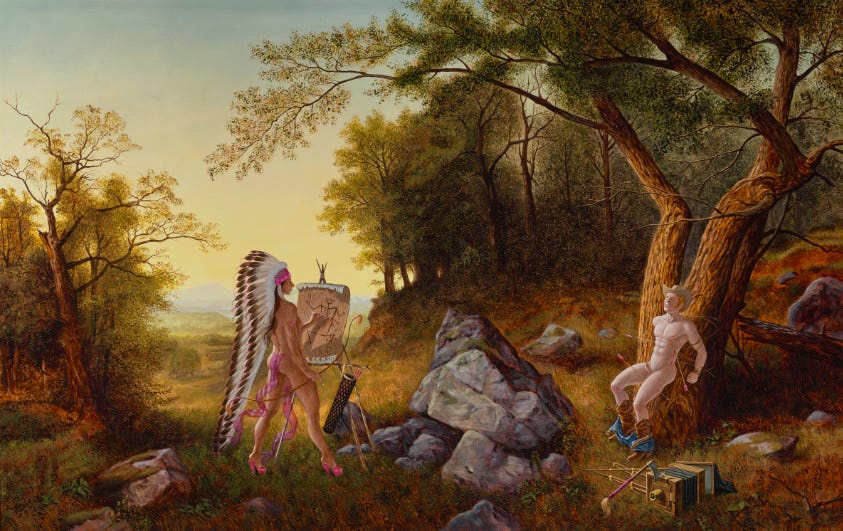
Monkman’s work is pornographic kink and a fetishization of progressive activism. What’s telling: the rare instance a woman makes an appearance in his work, she is often frumpy and homely, whereas the gender-queer Indian is depicted as more sexually appealing. The fourth floor at the Denver Art Museum is an outright rejection of beauty and fully embraces the transgressive.
While art like this exists in a museum, modern media marinates us in it. A television commercial will make a husband a childlike dolt, and a woman married to him finds her sexuality, personal expression, and personal happiness to have found a graveyard from which she yearns to escape. You can go on Instagram, see a picture of a family from the 1950s, and it is inevitable to read sneering comments about the father being a physically abusive alcoholic married to either a dumb woman or a woman stifled in all manners by her husband, and kids who grew up with emotional issues—yet this somehow makes the kids enlightened, especially if they hate their parents.
What does a culture move toward when the transgressive is hailed versus when the beautiful is hailed?
Counters to Roger Scruton
Beauty is a masterpiece, an important piece of philosophy that would benefit anyone. Scruton is an icon; Roger Scruton would be a nightmare in an HOA. Scruton is a snob. Scruton scoffs at anything lowbrow.
On Kitsch
Roger Scruton excoriates kitsch art as anti-beauty. He says kitsch art seeks to destroy the good and the true. I agree that much of kitsch art is silly, looks garish, and is forgettable. For instance, walk into a boomer’s house and a good chance exists of seeing it cluttered with kitsch. Like the wooden signs with clichéd humor:

You see these signs in the bathroom featuring corny defecation jokes, above with jokes about dishes, and near where alcohol is kept telling us how it’s “five o’clock somewhere.” Yes, it is all largely silly, largely tacky, and largely a pile of clutter. We also see kitsch on T-shirts, often a man wearing some self-castrating shirt about his wife being his boss, and the wife wearing a shirt saying “I’m with stupid” that points at the husband. That, in the theme mentioned above, is all about attacking tradition and buying into the idea of how awful marriage is. I hate this form of kitsch most. It is self-castrating. It neuters personal strengths. It neuters sexual polarity between a man and husband.
Yes, kitsch gets overwhelming, it gets silly, it looks like clutter, and it can be self-defeating.
But Scruton needs to lighten up.
Some kitsch art or elements of it can draw up a special memory, a moment. I do not see how a reminder of that moment somehow pulls society into ugliness when instead it keeps us grounded and honoring something of the past. It may be a coffee mug you got on a trip with your father. Dad might be gone now, but that silly mug brings a moment of special reflection while sipping your morning coffee. Perhaps that silly sign Grandma had over the sink; your daughter always liked it, and it went into her bathroom. As she has gotten older, it perhaps sits somewhere on the wall of her apartment—a reminder of Christmases at Grandma and Grandpa’s. Whatever it is, some kitsch has a place; it can stir a memory. When it wades into clutter or hanging onto the past so much that it becomes vicarious, yes, I understand and agree with Scruton’s position. But that points to an issue the person needs to work through. A little bit of kitsch, something with sensibility, meaning, and done tastefully—like that garden gnome sitting in your garden that perhaps is just like the one your grandpa had in his tomato garden—is not going to bring down the West, nor is it an outright desecration of beauty as Scruton claims.
On the Primal Expression
This counter entails the elements of pop culture, fashion, and music. Scruton, both in Beauty and in other writings, scoffs at elements of each. He sees them as anti-beauty.
How Scruton discusses each element and decries it, he misses aspects of human nature. For pop culture, it is more or less the masses enjoying something simple and of their times. It may be celebrity gossip, music, or something viral. Yes, at times it can be somewhat engineered by legacy media at the cost of other fashions, tastes, and traditions, but on the whole it is the masses enjoying various elements of life. Much of pop culture is not highbrow. Sure, it would be great if more highbrow work were featured, but highbrow does not speak to everyone. Even those who are more highbrow oriented sometimes are drawn to something primal or easy-humored because it offers release or joy. In other words, some people want to blow off steam or have a simple enjoyment. Pop culture has a socializing feature, much like getting together at your local pub. While our modern day has an issue of isolation, pop culture, when you are out and about, still makes it easy for people to connect. At the gym someone can laugh about the latest thing going viral. A group of girlfriends who haven’t seen each other in a while may get together and have a lighthearted discussion about the latest thing. Pop culture can have, in its various features and elements, a sense of spirit about it. Not everyone enjoys it. Current pop music suffers compared with popular music of twenty years ago and earlier. But still, various songs hit, and it has a unique way of pulling people together. A guilty-pleasure movie, song, or book has a lightness to it. It draws out joy, fun, spirit, a time of our life.
Let’s turn to music.
I share Roger Scruton’s disdain for the band Nirvana. While not covered in Beauty, he does write about the band elsewhere. Nirvana ushered in an ennui that spread like wildfire, and much of modern music, especially rock, has never recovered. I personally cannot stand the sound of Nirvana, their songwriting, or their utter nihilism and ennui. And how it became edgy to like them—that edginess felt like a shtick to me, the “woe is life, woe is me, everything sucks” clichés. Some say Nirvana was needed to end cheesy hair metal of the 1980s. Yet, as more and more comes out about that era, it looks more and more like tastes did not change overnight; rather, presidents of radio stations simply scrapped 1980s glam rock in favor of grunge.3 Grunge did not have the lasting impact; it faded before the end of the 1990s as tastes moved on and many of the stars, like Kurt Cobain, died. Regardless, Nirvana signaled an end of rock music being fun and its shift to being largely introspective, emotional, nihilistic, and about personal anguish.
Aside from that, Scruton veers into pearl-clutching, saying music such as the Rolling Stones influences degenerate behavior, that the Rolling Stones are anti-art and beauty, and that their music is grating. It is here, and not just on the Stones (though I do love the Rolling Stones), where Scruton misses, ignores, or rejects the primal element of our human nature. This is a shock since he writes so beautifully on the Eros, which contains the primal features and expressions of our nature.
Consider Mötley Crüe. A band full of debauchery, wild tales, and hedonistic lyrics. Many people decry a band like Mötley Crüe. Many have said listening to Mötley Crüe is akin to worshipping the devil, or that if your child hears it once, they will instantly turn into a degenerate mess. That is pearl-clutching and moralizing. It smells of insecurity to believe that if a woman listens to Mötley Crüe she will suddenly start an OnlyFans and try to rival Bonnie Blue, or that if a man of faith listens to Mötley Crüe he will suddenly find himself a drug-addicted criminal. These puritan claims smell of purity signaling and insecurity, sure, but most of all they deny the human spirit.
Mötley Crüe captures a primal spirit of human nature. Their sound captures the spirit of youth, rebellion, release, ambition, fun, and carnal desire. Absolutely, parts of this spirit can run wild and lead us into dark places, regret, excess, debauchery, and spiritual enervation. But that is on the disposition and education (experience, parenting, school, culture) of the person, and sometimes it is youth itself that provides experience and wisdom to forge our virtues as we mature. Scruton misses that this spirit wants to come out and always has. Erasmus in Praise of Folly mocks the “high brow” and moralizers; he shows that to beget children, to laugh with friends, to grease the wheels of life, and to live a life that adds strength, depth, context, perspective, and wisdom behind our virtue requires that spirit. Great cities would not be built without that spirit. Vetting and dating for a husband or wife comes with that spirit. And the humor that can connect people or help us with self-honesty all come with that spirit.
Vernacular, too, can entail the primal part of our nature, the spirit, the release. And yes, at times the primal can get away from us easily and lead into the crude or pornographic. But the thing is, containing the primal is a challenge, and cultures that try to contain it have a habit of not thriving; they are often oppressive and stagnant. The belief that if someone listens to a song then a person and society are cooked is an insecure form of heteronomous determinism. What does it say of the man if he hears Poison’s “Nothin’ but a Good Time” and goes from a straight-edged churchgoer to a drug-addicted criminal? What does it say of the woman if she hears Nicki Minaj’s “Anaconda” and that is what leads her to compete against Bonnie Blue as to who can be the wildest gonzo OnlyFans star?
While you can answer it yourself, it wasn’t that a Rolling Stones song put people over the edge. People who go over the edge have innate psychological and dispositional factors motivating them, willingly, over the edge. Yes, these songs can have a kind of influence, but they are not the agency of the person. The person makes the choice and begets the action; they are not a zombie. As said, the primal will come out in some manner, whether it is song, sensuous or sexual dress, or what have you. A more troubling concern today is that our primal expression happens increasingly vicariously. It occurs more and more online and less so in person. This vicariousness Scruton discusses, particularly when he discusses pornography and its turning the Eros into a cheapened experience.
If one were to have a solution to steer us toward higher beauty, it will come down to more and more individuals yearning for higher beauty in culture. Which is a battle. Our education system scoffs at beauty. We are taught to hail anti-beauty, such as “fat is healthy” movements. The decorum of dress has lowered. I argue that lewd dress is not the main problem; one gal showing too much skin calls attention, but that attention distracts us from the more pervasive issue of personal dress: the pajamas and athleisure mentioned above. And for many people, those clothes accentuate their aesthetic defects and accentuate the modern issue of pervasive obesity.
How we address the cultural lowering of the bar is multifaceted and complex, but it will have to come from the bottom up, not from policy or someone’s moralizing vision blathered on X. Still, it is impossible to fully contain the primal, but perhaps we can inspire sensible restraint of it. For our culture not to succumb to its darkest corners, we need the good, the true, and the beautiful to sway us toward a higher ideal.
Why Read It
Beauty is a masterpiece of philosophy. It is a masterpiece of wisdom. Reading it, you will walk away with a better grasp of art, your eye will sharpen, your taste will deepen, and you will have a more meaningful grasp of the beauty of the green fields of Nebraska as you will of the beauty of a Winslow Homer painting, and a better appreciation of the design and architecture of Seaside, Florida. Scruton does have a habit of name-dropping particular philosophers that may require looking up, yet on the whole he is accessible.
I especially recommend this book to people who consider themselves on the right and have heard that the right doesn’t care about art or has lost the culture war, as was claimed by right-wing journalist Christopher Rufo. This book proves that claim to be self-loathing and made from ignorance. Here are some names of famous right-leaning modern creatives from a variety of backgrounds:
David Mamet
Nicki Minaj
Howard Subin
Sydney Sweeney
Vince Vaughn
Jon Voight
Clint Eastwood
Clint Black
Chris Pratt
Scott Johnston
Tom Wolfe
P. D. James
Mark Helprin
Mel Gibson
James Woods
The contributions from the right are significant, Scruton’s book being among them.
Beauty is a work well worth reading. It won’t take long, and you will walk away with a lot.
https://www.denverartmuseum.org/en/kent-monkman-exhibition-guide-power-visual-authorship
The claim goes that Grunge Music (Nirvana, Alice In Chains, Silverchair, Pearl Jam, etc.) killed Hair Metal. First, hair metal was a term that came post the 1980s early 1990s and was used as a pejorative, much like how some current Yach Rock bands hate the term Yacht Rock. But 1980s rock, which went into the early 1990s was just known as rock music and some called it glam rock, glam rock being a sound starting in the 1970s with bands and artists like David Bowie, T.Rex, Sweet, Alice Cooper, and Queen. The sound of 1980s glam rock spawned from an area in Hollywood called the Strip. Mötley Crüe were early on the scene. The scene spawned massive multi-platinum artists, and it was a wildly popular sound. It also lasted through the decade, and while some of it was getting tired and over done, a sound shift was happening. The virtuoso sound, whether singing or guitar playing was coming in, with bands like Extreme or Steelheart. The other sound, was a more bluesy, southwestern sound, where Cinderella and Poison seemed to be heading. Nirvana exploded onto the scene in 1992 and in one week, all the popular hair metal bands were off all the playlists. But here is the odd bit, the albums released by those bands, and even the singles, did remarkably well, but were never played on the airwaves. The head programmer at MTV, newly hired in 1992, hated the sound and said he would never play Mötley Crüe, Poison, Dokken, and so on. And at his previous radio station, K-Rock, he didn’t and once hired at MTV, then a powerhouse of commanding tastes, once Nirvana arrived, that was it. Alice in Chains opened for Poison, and the fans loved both. Given the popularity, millions upon millions of albums sold without dwindling popularity, it’s hard to reasonably say Teen Spirit killed a sound loved by millions for over a decade. The music business looked to have killed it.
Thought provoking read Jim. You describe something I’ve found frustrating about living in the Denver Metro area: for all the natural beauty it has to offer, its residents don’t seem to have an appreciation for it - athleisure, baseball hats in every restaurant, and cookie cutter architecture. It seems as though the endless natural beauty surrounding Denver has made its residents take beauty for granted.
Your call to action to this ailment is a nice reminder: become a student of beauty and cultivate it in areas you can control
I like how well this spoke to me.
Sorry for not reading and responding for such a long time. I had so much to read over the last two weeks, as I subscribed to too many newsletters.
Reminds me of how I’m working on my Elven races, being all women.
Especially the new one I created on the world of Interitus (I pretty sure you’d know what that means, so I won’t ask you to google it to see what it means in Latin) — After a nuclear war, 120 people gathered together and asked God to forgive them and to give them hope after 7 years of nuclear winter. One single ray on sunlight broke through the gloom and clouds, touched the ground, and in front of them, Lumindrial was born in front of them.
She started to sing towards the heavens, and all the humans there joined her, and the clouds started to part and as each ray of sunshine touched the ground, another Elf was born in front of them.
When they bothered to check the geiger counters, it was neutral again, no trace of radiation…
I had ChatGPT create the scene, and I would swear you could see that as an impressionist religious painting that you would see in the Louvres.
Then you get Eros, next Elven world is run by the Pirate Queen, who is in a now cold war with a world empire, who she has basically gutted one bed romp at a time…
Let’s say, there are four Elven races, and three will live quite harmoniously, and the other will not do so well!