

Knut Hamsun’s Hunger is the story of a starving, manic vagrant roaming the city streets between writing projects. Hunger tells a truth of the human condition: we’re all irrational. Hamsun, unlike modern self-development sciolists, doesn’t leave us with the notion that irrationality is a blight to expunge from ourselves. Hamsun shows that irrationality is innate to our psyche; it’s a part of our lives for better or worse and all the parts between. It’s innate to the human condition. An irony of our innate irrationality is that it fuels consistent patterns of behavior, so consistent that it can lock us into a cycle of a given endeavor. Some mistake irrationality as solely manifesting chaotic and unpredictable behavior. Sure, it can at times, but usually when we know someone as “chaotic” it isn’t because of a one-off event; it’s because we see a consistent set of choices they make. The reality is, for everyone, mentally healthy or unhealthy, irrationalities are innate to the psychological nature of humans. With the main character of Hunger, as chaotic and wild as he is, we see his consistency. And it’s all too human. For instance, once he gets money, he tells himself that he will not blow it all and that he’s finally come around the corner to have a handle on money, only to blow it all again. Another instance: he gets a writing idea, tells himself as soon as he gets home he will start right away to capture his brilliance. Once he gets home he finds reasons not to get started, again. These cycles are consistent and true of all of us. And as Hamsun brilliantly conveys, cycles also reveal our tortured relationships with certain endeavors.
Dating is often a tortuous endeavor for men and women. Tortured, here, not always meaning broken, crazy damaged people blowing up relationships and leaving a trail of trauma, regret, and anger in their wake. Those people exist. But tortured here means the sense that a man or woman, despite best intentions, personal self-esteem levels, well-adjusted or maladjusted, seems to have a habit of the relationship they desire constantly eluding them. A few long-term relationships fail, for various nuanced and general reasons: fear of commitment, always picking ill-suited matches, hanging on too long, abrogating responsibility in their choices, or refusal to deal with fears of being alone. Tied to that, a lot of short-term situations that appear to start off great to the love-starved guy or gal, only to implode, leaving one or both wondering, “How did I ever get into a thing with this person?” Or choosing flings for fun but repressing the fact that they’re wanting to hook up with new people, telling themselves they’re doing this to not settle, and that repression having the habit of stoking internal and external disorder. In other words, dating can be fraught with confusion, fear of never finding that great match, chaos, anxiety, the consequences of repressing accountability, self-doubt, and regret.
The drama’s antagonists are called characters; our knowledge of their character is limited to their actions; they made this or that choice, and it resulted in this or that outcome. The outcome was not determined by their “past lives,” or “race,” or social position, or sex, but by their choices.
To the extent that we are rational, we determine what people mean by what they do.
— David Mamet
I’m going to speak from my dating experience, which derives largely from the urban dating scene in Denver, Colorado. I’ll speak from personal experience and observation. Denver, like any area, packs men and women following their own ingrained patterns of behavior, following a consistent set of choices leading to a consistent set of outcomes, which keeps them in a cycle of enduring tortured romantic relationships.
I endured a cycle of tortured relationships. I used to undervalue myself. Not in a self-defeating manner, but in the manner of being oblivious to the value I brought to the table. I swung pendulums between dating the bad girl to then “hitting the reset button” to then dating the prig. I was choosy, but had a bad habit of ignoring the girls pursuing me and going after women offering a challenge. I didn’t want to “fix” her—you can’t, nor can you save her—rather, it was women who offered a kind of challenge, whether it be their emotional disposition or an endless amount of hurdles. That all fed an internal scoreboard of me competing against self-created and always moving goalposts. It all made for a faulty vetting process. I’d pick a poor match, not a slight mismatch, but an outright poor match. A relationship with a poorly matched person has the habit of manifesting the features of self-doubt that keep us stuck to those poor matches. For me, if she was ice cold, or unbearably overwhelming, or outright behaved poorly, I would castigate myself for not being the Ubermensch Alpha male months ago, and take my not being the Ubermensch months ago as the root cause to explain her behavior in the moment. Fortunately, when I found myself venting to the steering wheel of my car or buying Stop Walking on Eggshells and reading it in secret, I knew I had to end it.
I had had enough of the cycle by early 2020. I broke the cycle through self-analysis, getting wisdom from a rare pro-masculine psychologist (I know how lucky I am to find one like him), and deep personal realizations. It caused a late personal blooming in June of 2020. I went on to vet and enjoy great matches and found the best match with the woman who became my wife (shockingly, I came close to meeting her a number of times going back to late December of 2004, and so many times throughout the years, and in such a fashion, that it makes me wonder about the Invisible String Theory, as irrational as that may be). I, like many, endured a cycle not wanting to endure that cycle, and am grateful I freed myself from it.
The cycle is hard to generalize, yet a common flavor prevails, regardless of how nuanced and different the ingredients are comprising that flavor. Many in the urban dating scene, after a failed relationship, after a string of flings which failed to yield, yet again, the satisfaction promised, now claim to have changed and are eager for the fresh start only to find themselves right back in the spot they swore they wouldn’t be in any longer.
Finding themselves in this place again, well-intended people say it’s time for a “reset.” They might beat themselves up a little, maybe ruminate if they’re broken or somehow something—the past, trauma, not being the Ubermensch—got them into this place of frustration again. Yet, they decide not to play victim, “refuse to settle this time,” and tell themselves that they’re deserving of something great. They “hit reset” and jump right back into the same cycle, eagerly and willingly making the same pattern of choices as before, and then wrangling to repress those choices as they get the same outcomes as before.
A common first part of the pattern—imbued with dispositional and psychological intricacies particular to a person—is the “reset.” The motivated want to figure out their love life this time. They may read The Love Languages, Way of the Superior Man, Attached, The Four Agreements, or other popular bumf. Whatever it is, they turn to some expert or school of promises to find the secret.1
They journal a list of meaningless wants:
Is a good person
Loves to travel
Likes adventures
Is spontaneous
Is healthy
That’s general to both sexes.
Women tend to list:
Gets along with his mom (it’s telling that “gets along with his father” is never listed)
Is successful
Anticipates her needs (aka, mind reading)
Owns power tools (or some other token symbol of pop masculinity)
Isn’t intimidated by her career
Has a job (the shallower go with, makes 6+ figures, has abs, and is 6’2”+)
Listens/communicates/can talk about anything, even the hard stuff
The last point always misses that she herself struggles or outright refuses to open up and articulate her past relationships and hookups with radical honesty. Instead, many women hope any inquiry of her past never gets past deflections of, “It was so long ago; I was a different person then”—which camouflages and acts as a palliative for the repression haunting her subconscious. Ask a woman who claims she wants someone she can talk about anything with, even the hard stuff, how many men she’s slept with. One in ten will give it to you straight without pretensions. The nine out of ten will get offended, lie, reflexively counter with feminist bromides, offer rationalizations disguised under being a different person then, or deflect by presenting a self-image of how she wishes to perceive herself. I have some sympathy for the nine out of ten. Because nine out of ten men manifest various insecurities when learning about a girl’s past. They’ll project their sexual insecurities or hold her past over her head to hide his feeling inferior to the men she had sex with previously. Still, regardless of her claims of being changed, she in each of those past moments chose willingly and eagerly to hook up or get into a relationship with a guy.
Men make a list as if they’re looking for a buddy:
Likes sports
Drinks beer
Drama free
Isn’t a gold-digger
The last point is almost always uttered by men well outside the top one percent of wealth or wealthier. It’s more or less a red flag when it’s uttered. It’s usually uttered by insecure men, the kind of guy who buys into manosphere ideologies of women being agency-less beings but having an innate Machiavellian nature seeking to screw men over. These men are petrified of being cheated on, so much so it’s a complex. And they’ve absolutized a woman’s body count into a moral law to such a degree that they seek their mirror: someone as self-loathing and as insecure as themselves.
Each sex, armed with that list of clichés, dogma, and therapy culture claptrap, believes this time they’ve changed. That they’re a different person now. They’ve done “the work.” They’ve “elevated to a new level” and are ready.
Days or a short few weeks after the last failed romance, they’re back in the dating market, oblivious that they’re using the same superficialities to vet people and adhering to the same dating patterns and making the same choices as before—a pattern of romantic decision making likely no different than they used when they were teenagers.
But this time is different!
They told themselves it’s different this time.
They did the work!
They journaled that they’re deserving and will not settle for average. They’ve studied some game or romance advice and told themselves that they’re better armed to win someone over. Despite dating apps being a massive source of chaotic and dispirited dating for them before, they’re right back on the apps: Hinge, Bumble, Tinder, Coffee Meets Bagel, and Raya. They’re out on the social scene (almost always revolving around drinking). And they’re “saying yes to life” and signing up for activities they wouldn’t otherwise do, like men signing up for Sunrise Yoga at Red Rocks and women signing up for kickball at Sloan’s Lake.2
Each sex gets dates. They date around. They may date multiple people at the same time. Here or there someone seemingly “checks all the boxes” on that superficial list. This time, since a person “checks all the boxes,” a romantic vision of the perfect match is hoisted onto that person, and the hoister tells themselves it’s love or at least maybe heading that way, all while ignoring gut feelings, overlooking red flags, missing that the person is a mismatch at a basic level (one wants kids, the other doesn’t), and the hoister, once again, ends up confused and conflicted when the person who had checked all the boxes turns out to be an awful match, a total knob, a chore to be with, or whatever else. The next time, this person takes a “new approach” and decides to just go with the flow, see where things head, and like before, ends up in a situationship with a mismatch, both people never quite communicating with each other directly about intentions. For both scenarios the relationship ends with each having distaste for the other.
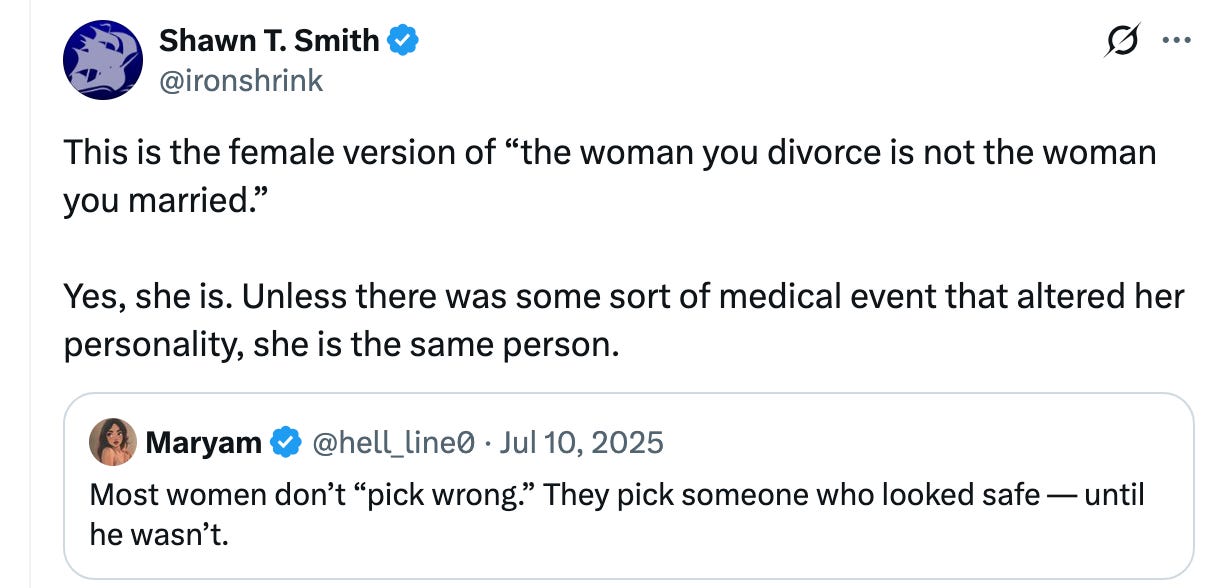
After a few times of this repeated outcome, the fashionable thing for women is an obligatory post on social media telling the world what she’s no longer accepting in her life, that she’s a different person, and she’s finally ready for the next stage. On top of that post, in a more intimate setting, whether journaling to herself or telling a close friend, she’ll proffer fashionable therapy tropes like her past, trauma, or the guy not being what she thought as a reason for her last outcome. Then she may sprinkle in therapy culture claptrap: blame the parents, blame what men did to her, blame the patriarchy, blame religion, and blame the men in her city. She blames anything other than herself for an outcome that is a result of the choices she eagerly, excitedly, willingly, and knowingly made.
The public post women deliver—written by a spectrum of women from the unhealthy and undateable to the healthy and dateable but metaphysically drifting for some reason—reveals insight into a pattern of choices leading to consistent outcomes. The post is self-aggrandizement, not always out of narcissism, but for want of a palliative. To cut through it all, it’s an act of repression. And repression has a way of fueling the crazier parts of our irrationality and keeping us in the same cycles, for both men and women. The woman does not admit she is in the same pattern. She does not take accountability for her choices because her choices determine her outcome. She feels she’s being rational and not irrational.
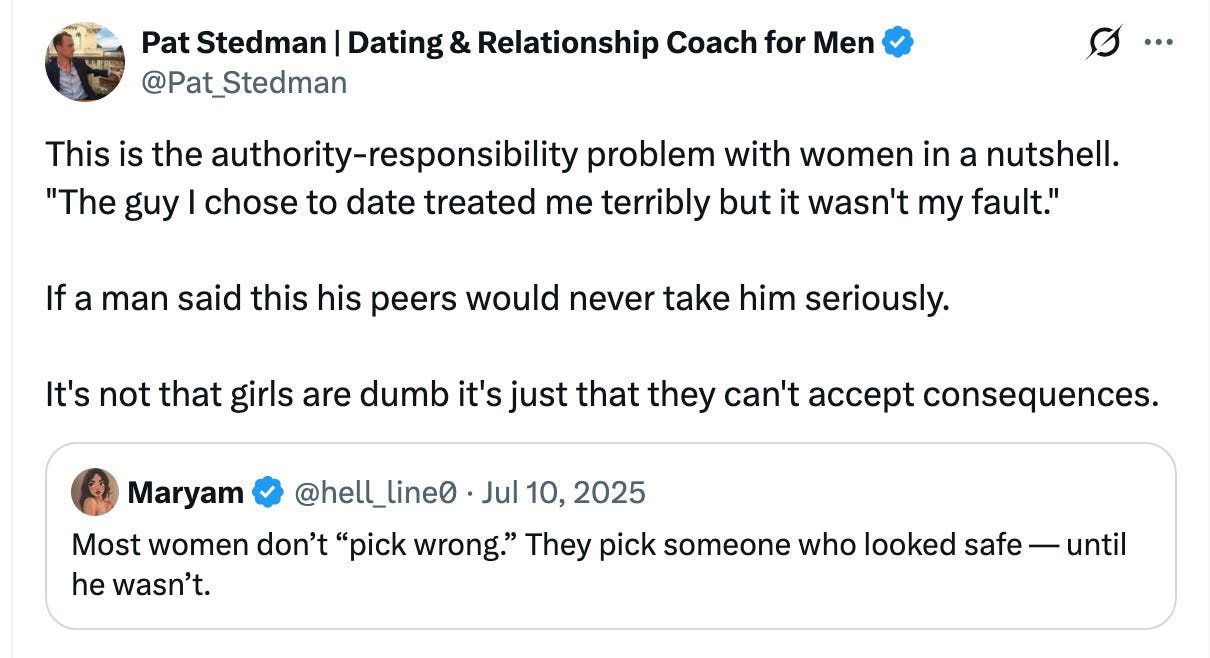
Men have their version.
For the mob of immature, insecure, or men of lower value—or a combination of all three—their pacification methods look like this. If it’s a longer-term relationship, the crazier the breakup, the more insecure the man: he publicly proclaims this breakup has truly taught him how to love and what love is and that his now ex-girlfriend gave him a gift to be a better man. Some write a clichéd post of how they’re ready to take charge of what’s next in life. The Peter Pan types, ubiquitous in Denver, will try to make themselves look like a hip and chill badass in hopes of making his newly minted ex see what she’s missing out on. For the shorter-term fling, the cad will likely not post something but will tell his friends that she was a crazy drama queen, brag of sexual acts she did to him, and then try to get as many dates as possible on a dating app. Also widespread among this mob, they will just stop talking to the girl. They’re scared of conflict, too cowardly to take responsibility and end it like a man. At best and common in Denver, the genera-bro texts saying they’re not ready to commit right now because they’re “heads down” at work and life is crazy, and it wouldn’t be fair to her or himself to date, given how crazy life is right now and she’s a great gal who deserves a guy’s full attention… followed up with ploys for future hook-ups.3
Whereas the more high-value men tend to ruminate and get overtly self-critical, thinking they need to overhaul some aspect of their character, get too internal, and miss that it was simply a mismatch.
After this period of “doing the work,” both sexes re-enter the dating market (women tend to re-enter the dating market instantly whether it’s after a breakup from a long-term relationship or after a fling with someone has ended). They date around, or even date multiple people at the same time. And for some guys and gals, either out of a pattern of behavior, a sense of pleasure (guilty or not), following more urban dating styles, or a combination of some or all, the term dating here is more or less a euphemism for either sleeping with multiple people at the same time or sleeping with new people in quick succession.
For women, in this urban instance, the word “dating,” or the New Age jargon phrase like “Empowered Dating,” attempts a linguistic rationalization to make it sound like their dating life is not just about sex. They believe, and know from experience, if dating or hook-up prospects knew they were sleeping with multiple people at the same time, or if not at the same time, new guys in quick succession, it makes it harder to obtain their goal of monogamy or may scare off desired prospects, regardless if that prospect, to her, is a potential long-term relationship or potential for a hook-up. She also wishes to uphold the image she created for herself that she’s a sophisticated dater. And for this group of women, many told themselves they were going to stop hooking up with guys as they look for a relationship and get serious, only to hook up with different guys in quick succession while looking for a guy who “ticks all the boxes” like before. The patterns repeat, the choices and outcomes are the same as before, and from the outside, we see her cycle, we see her consistent dating pattern. Internally, women, like the character in Hunger, tell themselves this time is different, they believe they’re being rational, and once again, irrationality glues them to a pattern they claim to have done work to free themselves. Less talked about, but known to those partaking in this style of urban dating, is that it’s fairly common knowledge that casual hook-ups are less sexually satisfying and instill regret and guilt later. And it’s common knowledge that dating apps are for hooking up; they’re just a few shades off from OnlyFans. Most women in this cycle know that, yet tell themselves they’re doing something differently, and go right back to their patterns willingly and eagerly.
Playing the field is full of spiritual pitfalls but it isn’t always the worst thing. A river of distilled water yields no fish. Courtship is part of the human experience and entails colorful parts of the human experience. Even the devoutly religious can play the field without getting sexual, if they wish to remain celibate before marriage. Speaking pragmatically, it is what it is that some men and women wish to have fun, and that can entail sex. Yet one spiritual pitfall is when a sexually charged dating life is intellectualized and rationalized into something that it’s not. Calling it anything other than what it is builds mental and emotional binds. It will bear heavier consequences of guilt and make heavier the impulse to tell self-lies and deflections to hide the truth from a potential match. Which of course is a recipe for guilt. Another issue, when it relates to vetting for monogamy, vetting for that great match, the titillation, the fun, the sexual validation, the thrill of a new partner distracts from what’s needed—the needed pragmatic discernment of values. The fun also works terribly as a band-aid for the guilt and feeling unfulfilled. As Louise Perry and Mary Harrington poignantly detail in each of their books, The Case Against the Sexual Revolution and Feminism Against Progress, the sexual intimacy that makes the earth shake is rarely found in this style of dating. That style of dating more often than not dulls the pleasure and the disconnect foments frustration.
Yet repressing the truth of what one is doing builds the bind, it stokes the irrationality. No one wants to admit to themselves or the other what they’re doing. And to attract desirable prospects they feel they need to sell the right kind of image, which makes them forego vetting values and instead focus on winning in the sexual marketplace. That has the habit of attracting a match doing the same thing.
Thus the commitment talk on dates, whether on an early date or, and often, well after having sex, is Kamala Harris–like babble. It blends ambiguous proclamations of commitment “if the right person comes along” mixed with ambiguous proclamations of wanting to enjoy life—aka not wanting to commit but wanting to have no-strings-attached sex.
While that Kamala Harris babble occurs between them, if one or both is dating around, each will dance around the fact that they’re dating around with more Harris-like babble. The deeper bind isn’t dating around, it’s personally repressing the reality that they’re currently sleeping with other people, talking to new people on the dating apps, and setting up new dates, sleeping with old dates, and, possibly unbeknownst to them currently, will hook up with someone on that upcoming trip with friends. Yet here they are, in front of each other, dangling to the other that they’re “open” to commitment. Said another way, each serves the other a heap of bullshit with the hopes it betters their chances of getting laid with someone they find hot. With such focus on selling the right image, both parties absolve their capacity to observe the values of the other and to see if those values complement their values. Thus keeping the main goal of finding a great match to build a great relationship with elusive.
If either person is dating in that particular manner, actively dating a few people or actively sexual with new people in fast succession, it’s admirable, yet unfortunately rare, where on a first date, or inside three dates at least, they tell the other they’re dating multiple people and, if they are, having sex with those people. Or if not multiple people, is open to or is having sex with someone else, or at the very least actively going on dates with others or is open to going on dates with new people and that sex is on the table. In other words, radical honesty (this honesty is best served from someone with conversational tact, conscientiousness, emotional IQ, and confidence). For instance, if the girl or guy can answer “how was that trip?” with the truth that they slept with someone. But this honesty is seen as irrational. The person fearing rejection, men fearing the loss of sexual opportunity, women fearing the promiscuous label, will never tell the other they slept with someone on that trip they went on with their friends. It’s also deemed irrational for bringing up God and politics on the first date. It’s called irrational because, to most people, if we’re honest, as mentioned above, they’re worried that if they bring these topics up early it reduces the chance of having sex with the other person.
In the end, as is part of the human condition, the fear of rejection is too great for most. They choose to deflect, hide, or avoid the topic. They call it irrational to be that open because they believe it would sap their game. They miss how the lack of authenticity, to themselves and to the other, hitches them to the patterns they proclaimed to have escaped. This rationalized “rational approach” minimizes chances of finding what they truly want while maximizing chances of staying in that tortured cycle.
It’s not that this style of dating can’t yield a good result, but it makes yielding a good result difficult. All of those patterns create an internal chaos. Women complain of guys making it all about sex despite indulging in a sexually charged lifestyle. Unserious men complain of women wanting to commit despite themselves dangling commitment as a way to hook up. An innate truth for all of us, when we’re bound up with self-lies, contradictions, palliatives—aka repression—we remain blind to our cycle, doing the exact same things we’ve been doing for years and years, yet fully believe that we’re rational and that others are irrational. At the end of Hunger we’re not sure what’s going to happen to the main character. The only thing we know is that he’ll never escape his irrationality.
Not all experts are bad. Some good ones exist, the trouble is, they’re a rarity and excruciatingly difficult to find.
Red Rocks is the famous concert venue just outside of Denver, Colorado. Sloan’s Lake is a Denver neighborhood, in late spring and early summer, on Tuesday and Thursday evenings, Yoga at the Park, kickball, HIIT at the park are all offered, and it’s largely guys and gals cruising for dates.
Genera-bro (a term I’m proud of coining): possible clothes, flat-brim hat, Bird Dog Khaki’s, dress sneakers (like the Cole Haan ZeroGrand wingtip Oxfords), local sports team apparel, loose black t-shirt from Nordstrom to wear with a variety of bird dog shorts; possible profession is vague, but likely worked in tech or claims to have, company sold, has some coin, now runs a startup selling “elevated experiences” and calls himself a Founder; drives either a Land Rover, BMW, or a decked out 4Runner; activities include hanging with his crew, climbing, local sports teams, skiing Breckenridge or Keystone, boys golf trips, fishing trips with the boys; is good looking and good looking on a dating app list; complains of dinner bills, of the girl not wanting to drink beer with him, has grey areas with past ex’s and his live Tinder profile is because he forgot his password; last book read was Obstacle Is The Way by Ryan Holiday or Principles by Ray Dahlio; accuses the girl of jealousy when he has an ex-girlfriend now just a friend stay with him at his timeshare condo in Keystone for the weekend. Ubiquitous in Denver. After a break up, will often text a girl how he screwed up, and she is great for him, and makes ploys for hook ups or to date.