

The two greatest theologians are St. Augustine of Hippo and St. Thomas Aquinas. The wisdom, arguments, theology, philosophy, and beauty one can discover from either would take a few lifetimes. I wrangled between these two. I wrangled out of needing to pick a confirmation saint. Currently, I’m going through my adult confirmation at the Catholic Church. Spring of 2027 is the confirmation, and a requirement of confirmation is choosing a saint. A confirmation saint works in two ways: intercession and imitation. Intercession is asking that saint to pray for you, guide you, and in a way, act as a north star for you. Imitation is in a sense emulation, but not outright larping as the saint. Whether it is the saint’s life, his ideas, his practices, or whatever it is about that saint, something resonates with you and it inspires you to walk in that path. I picked Aquinas after weeks of wrangling and whittling it down. And I’d be honored if some of you joined me on this journey of learning more about Aquinas.
Book Club: America
I’ve finished A Patriot’s History of the United States by Larry Schweikart and Michael Allen. The America topic is still happening. As I’ve mentioned, and for those of you who are new, I picked some doorstop books for America. The next book I’ll read for it will be the iconic A History of the American People by Paul Johnson. When I start that, I have no idea. I imagine I’ll read a few books on Aquinas then dive back into America. The rest of the books after Johnson’s:
Democracy in America by Alexis de Tocqueville (and will prime it by reading Pierre Manent’s Tocqueville and the Nature of Democracy)
Ethnic America by Thomas Sowell
Three doorstops left. Only a small few joined me on it, but it’s been a lot of fun.
A Recap of How the Book Club Works
I pick a topic, author, or book. If it’s a few books, like America, Rome, or, now, Aquinas, I curate a list of books to read. You can read along, whether that’s one book or any of the books, or you can be a fly on the wall and ask questions.
Lately, I’ve been working towards a once-a-week or once-every-two-weeks riff. I read, the next morning I sit down and riff out a two-part piece, I publish. I barely edit it. The first part is for all, the second part is exclusive to paying subscribers. The first part might discuss reading or some culture, or something that surfaces in my mind from what I’ve read. The second part explicitly discusses the book being read. I might give insight into how I’m approaching it, I might riff on what I’m seeing, or whatever it is.
Paying members will have access to a chat where they can ask questions, share what they’re seeing, start a topic of discussion, or whatever else it is. And you can reply to the riffs and get a conversation going there.
The more people engaged in the topic, the more I will do some livestream videos where paying members can come on and chat.
There are no deadlines to finish the book. Read at your own pace. And the topics, right now, are always open. For instance, I read Machiavelli a few months ago, if you’d like to read The Prince and have some questions for me, you can fire away in the chat thread for it.
I want you to read at your pace, and engage with it at your pace.
Thomas Aquinas
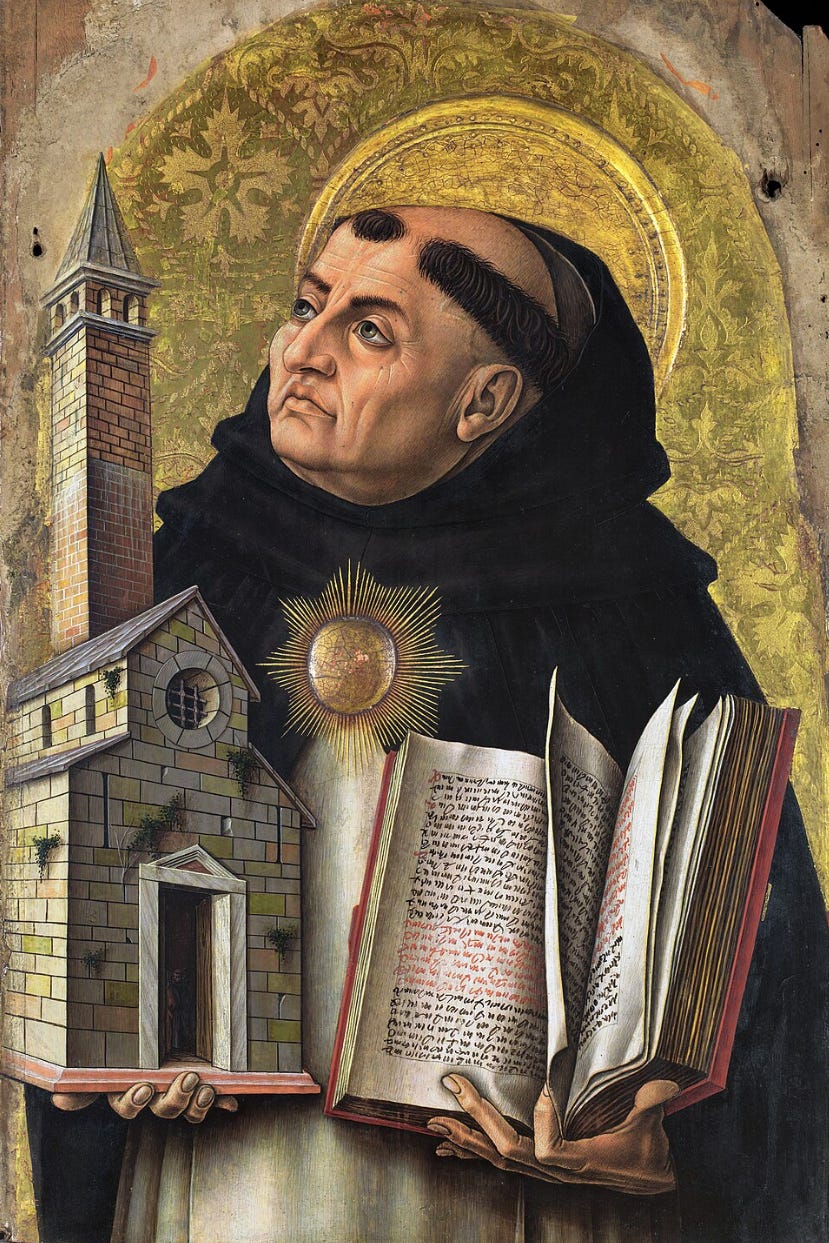
As I mentioned, I spent a few weeks thinking over my confirmation saint. I asked Grok AI, my wife, some good friends, and my priest.
St. Augustine and Thomas Aquinas kept coming up as one and two. I prayed one night and asked for more specific guidance for my confirmation saint. The next morning, the first email I saw in my inbox was this article by a favorite thinker of mine, Daniel J. Mahoney. Then when I went to read the latest issue of The Claremont Review of Books, and I opened it to Edward Feser’s article on transhumanism. The night before I had just learned about Feser, he’s a highly regarded Thomas Aquinas scholar. I then decided to ask Grok AI if it could narrow down the list, but I loaded up all my musings, outlines and riffs I’ve got going on a new article about my return to the Catholic faith. Grok AI overwhelmingly answered that Thomas Aquinas makes the most sense. My confirmation sponsor said Aquinas all along. And my priest texted me saying “Aquinas is perfect for you and fits you best.” I went with Aquinas.
My return to faith has been cerebral. And how Aquinas approaches faith resonates with me. He’s most famously known for baptizing Aristotle. The baptism was figurative, but Thomas saw the teachings of Aristotle, and saw how it aligned or related to Christian faith, from arguments about God, to how the world works, how reason works, and so forth. Thomas wrote the famous Summa Theologica, a comprehensive near look at everything, faith, creation, Catholic faith, morals, love, sexuality, pets, you name it.
Regardless of whether you’re a Catholic or Protestant or agnostic, one can’t ignore the influence of Aquinas on the West and the gravity of his ideas. Studying him is looking into ideas, principles, and convictions which still shape the world we live in, and seeing how cultural rot is an issue, Aquinas gives wisdom on how to handle rot or perhaps get us back onto a better path. He’s as important as Aristotle and Plato.
The Curated Works
G. K. Chesterton, Saint Thomas Aquinas: The Dumb Ox
Josef Pieper, Guide to Thomas Aquinas
Josef Pieper, The Human Wisdom of St. Thomas: A Breviary of Philosophy from the Works of St. Thomas Aquinas
Peter Kreeft, Summa of the Summa: The Essential Philosophical Passages of St. Thomas Aquinas’ Summa Theologica Edited and Explained for Beginners
Edward Feser, Aquinas: A Beginner’s Guide
Peter Kreeft, Practical Theology: Spiritual Direction from St. Thomas Aquinas
Josef Pieper, Faith, Hope, Love
Some of these are very short, such as Pieper’s Human Wisdom. The order listed is the order I’m reading them in. Some of you may already notice that these authors themselves are iconic theologians.
I’m hoping to begin Chesterton tonight, as of this writing. I’m doing readings for my confirmation, and there is a chance I will finish this week’s this afternoon. Regardless, this week I will begin Chesterton’s Dumb Ox.
This is short notice, but I feel called to dive in.
A note: Chesterton’s work is also called St. Thomas Aquinas. Some cheap versions exist. So when purchasing, look for a good one.
If you want to join in, whether that is reading one of the books or all of them, or wish to be a fly on the wall, comment below.