

“Abortion is a right!”
“Healthcare is a right!”
“Trans-rights are human rights!”
“Equality is not a privilege, it’s a right!”
Human rights are the harbinger of Western enervation. Not all rights are bad per se, but they’re theoretical; they’re based not on human action but on theoretical action. They are a counter to what makes society, in all its corners, right down to our daily lives, stable, free, and good. Rights counter, fight, and work to supplant Natural Law. What Natural Law is and the forces that counter it comprise the core aim of Pierre Manent’s Natural Law and Human Rights: Toward a Recovery of Practical Reason. While it’s a book on political theory and political philosophy, and one of profound depth and meaning, it’s just as profound and meaningful and just as much a book on human nature, psychology, theology, legal theory, culture, and social analysis. Personally, it’s one of the most profound works I’ve ever read. And Manent was the final yet biggest push for me to return home to my Catholic faith.
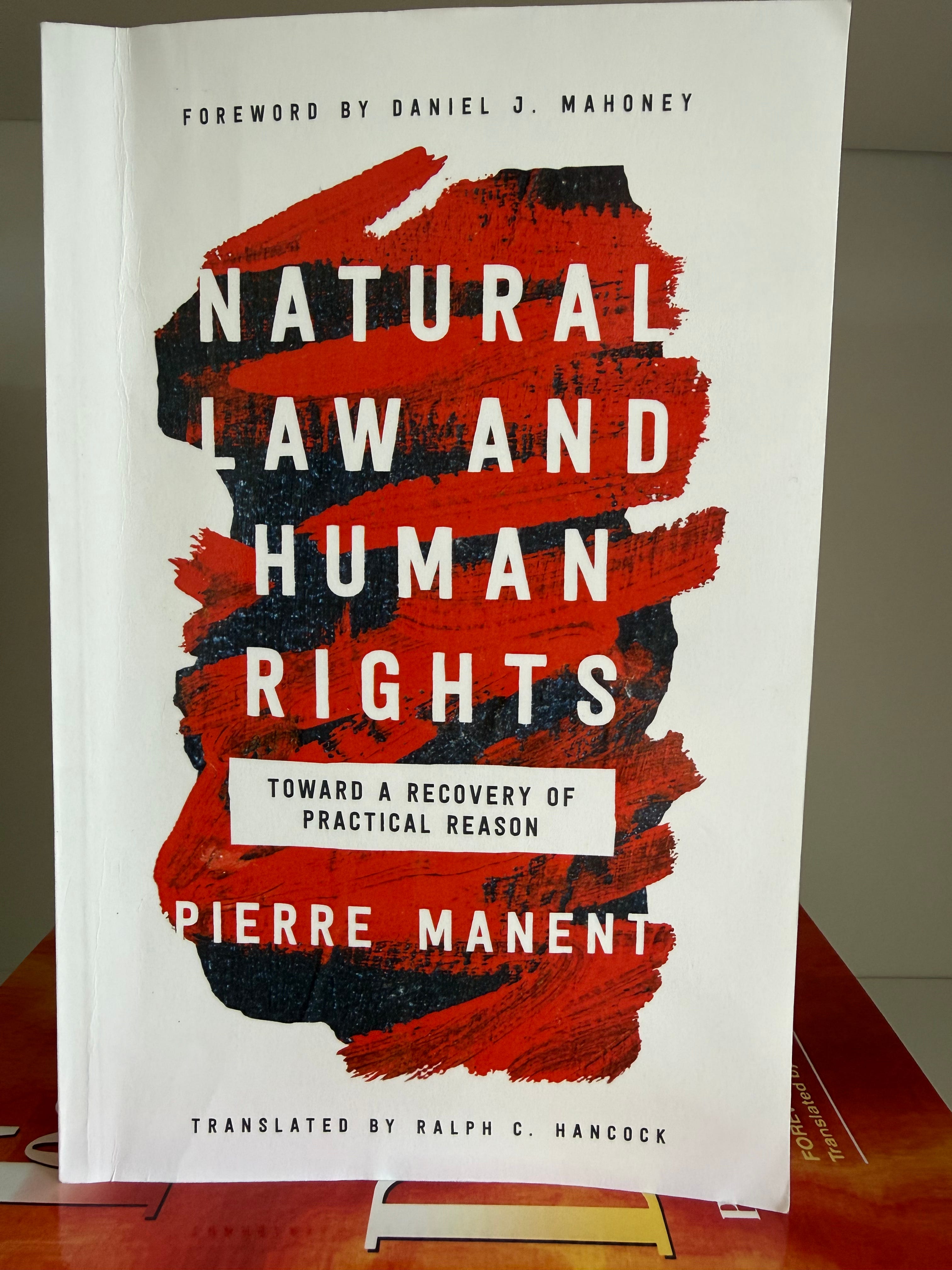
Who Is Pierre Manent?
Pierre Manent is a French political philosopher. He’s Catholic, conservative, and describes his thinking as a triangle: politics, religion, and philosophy. Manent is a student of Raymond Aron, who is of the Leo Strauss school, and Manent’s close friend and mentor is Allan Bloom, the author of the famous The Closing of the American Mind. Manent has an exhaustive background and understanding of Thomas Aquinas, Niccolò Machiavelli, Thomas Hobbes, Alexis de Tocqueville, Karl Marx, Aristotle, Immanuel Kant, Blaise Pascal, and, I’ll add, a gifted and exhaustive understanding of human nature. His writings in America mostly appear via the University of Notre Dame and The Claremont Review of Books.
While European conservatism, or rather the European Right, has different ingredients than the American Right, they do meet and align in various manners. But Manent’s work transcends the quibbling differences between the European Right and Left versus the American Right and Left. His work considers human nature, which transcends boundaries and is universal.
Natural Law versus Human Rights
What is Natural Law?
One definition from Natural Law and Human Rights:
Natural law is the law or practical principles that human beings do not make because those principles belong to their nature, but that motivate, illuminate, and guide man-made laws.
To help define:
The very notion of natural law presupposes or implies that we have the ability to judge human conduct according to criteria that are clear, stable, and largely if not universally shared.
And a little further:
Natural law as I propose to view it here offers precisely this advantage: while providing explicit and concrete criteria that make it possible to appreciate the conformity of an institution or of a mode of conduct to the natural law, it leaves the agent as well as the evaluator great latitude for exploring paths of improvement, or rather encourages him to explore such paths of improvement.
Natural law is innate to humans and universal to all humans. Where it goes sideways is through disordered reason or a form of ideological shortcut that promises a personal or cultural utopia that is, in reality, the result of misguided passion. For instance, tribes sacrificing children. That barbaric act is a form of passion to chase a shortcut to a promised land, such as better crops or heaven on earth, and it’s also wielded as a tool of power or manipulation.
Natural law is innate to us. And the law here doesn’t just mean something like going the speed limit. It’s the law that governs us humans, and it’s intuitive, natural, and we get it. It’s not always some grand moral question either. Yes, we intuitively know slaughtering a family in cold blood is bad, just as we know cheating on a spouse is bad, and just as we know robbing a store is bad. Natural law extends into daily events such as going on a date to a fancy steakhouse. We know to dress up and dress for the occasion, and given the place, environment, or reputation of the restaurant, it all gives cues to the appropriate style decorum to respect. Whereas if a woman shows up in a G-string bikini to this steakhouse, and let’s say it’s in a stodgy blue-blood Yankee part of town in Massachusetts, wearing that is purposely and performatively transgressive. While the G-string might be sexy, it’s the inappropriate place to don it, and wearing it in that manner is to knowingly shock, is to knowingly perform a stunt because the woman wearing it understands wearing a G-string bikini to a fine steakhouse is transgressive for the setting. Whereas variations of the cocktail dress, sensual or modest, are more appropriate. Just as a man showing up wearing a baseball cap inside because he wants to is also a rebuke of natural law, perhaps best revealed in the iconic Sopranos scene of Tony telling a young man to remove his hat at an upscale restaurant:
A key component of natural law, the engine of it, are the three human motives, which are universally shared and innate to human nature: the pleasant, the useful, and the just (noble or honest can also be used here). According to Manent, and Daniel J. Mahoney in the introduction, as well as Aristotle, all human action, all our choices, are tied to, result from, and are all willingly under our direction from these particular motives. Even when we or someone else is “wrong” or making an immoral decision, or is knowingly sinning, we all think, we’re all convinced, that we’re right in the decision and, again, decide and act willingly. That willingness is our agency choosing. The lyrics of a song didn’t make us misbehave, being drunk did not force us to hook up with someone, nor did society make you choose a choice you came to regret—you make your choices willingly, and often eagerly. The pleasant and the useful are the more natural, the more innate, motives. The just, the noble, is often where the theoretical or conceptual exists. Focusing on the pleasant and the useful, returning to our romantic date, we pick the restaurant in a way that kills two birds with one stone. The food is, hopefully, dependably good according to reviews or past experience, and the ambience is pleasant and in line with a romantic atmosphere, all that makes for a pleasant dining experience. The useful is picking this spot because the food is good, the ambience is good, and we know it’s useful to make for a pleasant and romantic environment. We get dressed to look and feel good, to attract the other, to present our values and ideals, both useful and pleasant. It’s one environment, but the natural law is there; each individual intuitively knows it and knows the unwritten rules guiding certain choices. The just, in this scenario, would be picking a place that perhaps openly aligns with held political opinions or ideologies or is for activism or not of activism. Most sane people do not pick a romantic restaurant based on the just, but in some cities, like Denver, progressives have a habit of making a stink about it.
Naturally, we can get carried away, just as we can get carried away with the useful. We can overindulge in pleasure. We can become obsessed with the useful and act as jaded cynics. But we make choices, good or bad, all with the pleasant and the useful in mind. The noble, as stated, is more conceptual, more theoretical. Yet it does have elements we know are sound, are right. The Tony Soprano example is an example of him enforcing the values of decorum. How he went about it is gruff, to some, but in his mind, and to others, he is just in his action since he’s willing to do what others want to happen but don’t act for whatever personal reason—to tell the young man to respect tradition and the environment.
Walking down a bit more, the natural law, and the motives comprising it, are tied to the archic command. As defined by Manent:
Since the human world is a world of action, a practical world, it is naturally or essentially archic. Divided into commanding and obeying—a person either obeys or commands—it is also held together and put into motion by an act that begins and commands.
Or, summarized aptly by Daniel J. Mahoney in his superb introduction (worth a read itself):
In his view (Manent’s), our ever-more-imperial affirmation of human rights needs to be reintegrated into what he calls an “archic” understanding of human and political existence, where law and obligation are inherent in liberty and meaningful human action. Otherwise, we are bound to act thoughtlessly, in an increasingly arbitrary or willful manner.
Rights and the concept of rights fuel the arbitrary and willful manner. The arbitrary and willful manner, argues Manent, was spawned by Niccolò Machiavelli and Martin Luther. Machiavelli, especially, discarded, rejected, and rebuked The Gap. The Gap being that space between what people do and what people should do. Or, you could say, the choices they make versus what they should make. The gap is moral just as much as it is psychological; it’s cultural just as much as it is social. We behave in a manner and we sometimes know what we should do but sometimes fail that should and act in another way, willfully. A simple instance: we know we should drive the speed limit but we often go five or ten miles over it. Manent argues that people who make self-defeating decisions tend to adhere to the theories and lifestyles emanating from that arbitrary and willful influence. Take certain New Age pseudo-philosophies. Most give license to act upon any indulgence and treat this indulgence as a pathway to enlightenment and, conveniently, it also offers pseudo-wisdom to rationalize if regret happens with that indulgence or the person wishes to call it anything other than what it was and cast the accountability onto an “old self” that is somehow no longer you, or onto a “story” or some other outside factor other than their volition and eagerness in their choice they now try to construct pretenses around.
Going further, Manent shows how individual, cultural, and political choices tie to Thomas Hobbes taking Machiavelli’s concept of fear and making it more appetizing via Hobbes’s moralizing cause. An easy example: “abortion is healthcare.” Not only is that an ideological cliché but it’s a doctrine people hand their agency over to in order to show fealty to the cause and to never stray from it. They see abortion as healthcare as a right and any objection to this claim must be rebuked harshly and even removed from culture. This removal, and process of removal, we see on social media, like this man, and the people in the comments, calling for the boycott of a coffee shop in Castle Rock, Colorado for serving coffee to a “Christian Nationalist”:

 Tiktok failed to load.
Enable 3rd party cookies or use another browser
We find adherence and hailing of the moralizing cause in media, from commercials, shows, and movies, all of which depict pregnancy as a kind of disease, family as backwards and always stifling to a woman’s potential and her sexual satisfaction, among other worldview-signaling tropes. These tropes align with “abortion is a right” and are concomitant with fashionable progressive ideologies. This is part of a wonky Command + Obey cycle that Hobbes spawned. At a baseline, all of us either command our action, our choice, or we obey either a command or an action, and from there begin or command an action. A simple example of obey: if you’re not a Catholic and you go to a Catholic church, and you have social tact, out of respect you obey the traditions and parishioners by not acting however you want to act. You don’t get up and throw tomatoes at the priest. You command your action out of an unwritten rule of behavior. Hobbes’s Command and Obey, which has now permeated institutions and much of the behavior of progressive individuals, is wonky because it is unclear what the command element is and who obeys. And the command is often directed at others who express disobedience. For instance, the corporate company that makes a DEI statement or initiative of some sort. They, or the board who approved it, do this action feeling morally sound and intellectually ahead, and they command this onto their business and into the public marketplace. But are they doing it from their own agency, or are they obeying a group or ideology that demands fealty to this cause? On a more personal level, going back to that coffee shop example, that place is about fifteen minutes or so from my house. That person outraged at the shop serving a Christian is not uncommon here in Colorado. The man is upset that this coffee shop does not have purity; he posts his rant; he feels superior. But is he commanding from his principles or is he obeying an ideology, or is it a mix of both?
Where Hobbes is dangerous, and what Manent exposes, and what we see today with our bureaucracy, is the goal is to remove government. Not in the libertarian manner, but to remove the agency of the individual. The bureaucracy and government should exist according to Hobbes, but not from individual agency; rather, it should exist from this amorphous Command & Obey cycle, where we don’t know if the media personality, the politician, or the local coffee patron is commanding or obeying. It’s a headless Leviathan, fully in charge and running a command-obey from an ideology that supplants human action and supplants agency. And rights, human rights, are the fuel and source of this Leviathan to snuff natural law into oblivion.
Vertical Line of Action vs Horizontal Plane of Action
Pierre Manent destroys the notions of simple heteronomy. Mahoney defines heteronomy in the intro: “Nor is he a partisan of ‘heteronomy,’ where acting human beings take their direction from the will of others.” Those others, philosophically defined, are outside or external forces controlling our choices. Partisans of heteronomy are best exemplified in the doomer generalizations uttered by pearl clutchers. That, for example, if women are wearing thong bikinis at the beach, it will make other women behave poorly. Another example: the blend of therapy-speak and New Age claims of “I was a different person then” when someone talks about past decisions perhaps now regretted or perhaps the person wishing to absolve all accountability for their past choice in lieu of a perceived conception of their current self-image they want for themselves and how they wish others to view them. Partisans of heteronomy always lay the accountability of an action on an external ideology or an external force.
But why do people choose to date from a position of progressive ideology? Why do 14,000 Gen Z American women each month decide to start an OnlyFans?1 What makes someone like Renee Good or Alex Pretti obstruct federal officers looking to remove criminals and aggressively goad the officers to “come at them” yet seem unaware of the lethal consequences? What makes someone choose Rights as their acting ideology and from those Rights make personal and professional decisions?
What affects our action, our choices, are our disposition and education—education here is not solely school but our experiences, culture, parenting, social circles, and so on.
In brief, the agent’s motives are not up to him, as to either their presence or nature; they belong to human beings as such, to human nature; but the way these human motives become his actions is up to him. His disposition with respect to action, his virtues and vices, are up to him.
Manent has it that true action, the innate “thou shall not kill,” to wear something modest and appropriate to church, derives from natural law; it exists on a vertical line of action. This vertical line of action is innate. These are the intuitive choices. From this vertical line of action we make choices. Not all choices are good, even if made along that line. For instance, how well or poorly one handles romantic relationships. A person may choose to indulge in desires with someone else other than their husband or wife. But within that vertical line, we know acting on that impulse, in this scenario, is wrong, may lead to regret, lead us to dark places, and spiritual enervation, yet someone will make the choice of infidelity willingly and eagerly. In other words, if we can’t contain our desires to various degrees our desires can consume us. Zooming out to legal law, most people with good reason know not to infringe on other people’s freedoms. You don’t rob your neighbor’s house, nor do you build an outbuilding on his driveway. That innate knowledge is on the vertical line of action.
The horizontal plane of action granted new pathways of license. We still act and when we act and believe we’re doing the right action. But the aspect of rights—“women’s rights” or “obese rights” or “trans rights” or “gays have a right to be married” or “blacks have a right to reparations” or “healthcare is a right”—in a sense opens up the door to provide a set of rationalizations and easier access to personal justifications. It gives license to a barista who harasses you to use pronouns; it gives easier pathways to a woman who wishes to be among the 14,000 women a month who are eager to sell their sexual expression on OnlyFans. The horizontal plane is a set of rules, a set of complexities that influence or direct action, or it gives an easier pathway to indulge in our desires, and we obey it or command it. Many groups of people blame the Sexual Revolution for our current cultural issues. That it infested individuals with a set of choices. But the Sexual Revolution did not alter human nature nor did it alter our actions. Rather, it gave license to indulge in desire (the pleasant and the useful). It offered labels of sophistication, free-spiritedness, independence, and more. The Sexual Revolution provided theory and justification if one wished to indulge in their innate desires, whether man or woman. Those desires already existed, they’re in no way new, they’re innate. The people with the disposition to indulge, however, were now armed with reasons to indulge and armed with formulaic pretenses if they felt judged. Though we can’t discount how certain concepts, like the Sexual Revolution, or the culture of a city can influence our behavior to certain degrees. This, Manent argues, is the horizontal plane. It’s this additional set of complexities, from the explicit, from external factors, that offer an additional pathway to how we choose. Consider critical legal theory. It works to supplant natural law and make all judicial decisions based on the horizontal plane of action. Critical legal theory postulates that the legal system is set up to favor wealthy white men and oppress all others, and that criminals are either a victim of this system or wrongly oppressed by this system. From this position, people will command and obey the ideology whether it be a judge or whether it be how someone believes they should act around police. And it also gives a person an identity; they portray this identity by showing fealty to the “correct” moral and ideological view.
Difference of Sexes and Generational Closeness
Manent shows how the concept of rights is ephemeral, that rights are wholly indeterminate, because the idea of rights is an idea that presupposes that the right existed sometime before it was “taken away.” Such as the recent demand for trans rights. Somehow trans rights were taken away, the claim goes, and by instilling them back, we get back to our natural nature. This is a Rousseauean concept. Most mistake Rousseau as wishing us to return to live in nature and be one with the animals. But Rousseau envisioned a kind of blank slate, that the natural law and inequalities that happened in human history somehow suppressed our natural state and our rights. Yet his rights, the concepts Machiavelli and Hobbes and Marx and the current progressive posture all push for, promise a utopia, a state theorized as our correct and natural state, but, again, it’s based on ideas that presuppose what existed. As in, they never existed. They’re whimsical; they’re a theoretical action; they’re made up. A way we see this playing out is in what I found to be both beautiful and potent, what Manent says about the sexes and generations:
One of the most essential laws is that which, as it were, holds together the difference of the sexes with the difference of generations. The other sex is the strange proximity which is furthest away; the other generation is the strange distance of what is nearest. No human being can by himself regulate this distance of this proximity. To try to do so is to enter into a vertigo, a loss of the self from which there is no return.
That passage sums up so much truth—personal, cultural, and political. Manent sees traditional marriage, one that can beget children, between man and woman, as best representing natural law and upholding the true and good in society. And that gay marriage laughs in the face of natural law because it cannot beget children. Manent reveals a truth: men and women are different. That the natural proximity to the opposite sex we have yet the disparity between the two sexes is a beautiful yet powerful postulation. A man’s nature, his psychology, his biology, is vastly different from a woman’s nature, her psychology, and her biology. One man’s disposition will differ from another man’s, despite some shared nature and biology, but each man has a far greater disparity from the differing dispositions of two women. This is what makes the world special. Yet the world of human rights tries to change this disparity; it tries to erase the differences between men and women, and does it by making men into awful, simplistic, and privileged beings. Whereas we’re much closer to the generations bygone, our parents, our grandparents; we’re close to them, despite them living in different cultural and social fashions than us, and our grandparents are further away, yet we inherit elements from them, a common sense to evolve wisely and smartly. The current progressive posture takes the torch of Hobbes and Machiavelli and works to denigrate past generations and erase the natural differences between the sexes.
Manent, however, is not a doomer. He believes that a way back to practical reason is possible. He believes it to be in the more traditional elements of Catholic sensibilities; he believes it is found in the more traditional sensibilities, not radical revolution. He makes a sound case toward a recovery of practical reason. And what drives this case is his poignant point: natural law is eternal law; it is innate to humans. It is around, despite the doomerism. Constitutional originalism is one such sign that natural law exists. That Trump forcefully works to address the nonsense of transgenderism, particularly men in women’s sports, is another sign that natural law exists. That the young men coming into faith prefer the traditional, prefer the Catholic church over the slick, fashionable Martin Luther descendants we see today with big-box churches. That schools like the Barney Initiative with its classical curriculums are a sign of the natural law. It will take time, but there are forces working against the damages created by Machiavelli and Hobbes in our modern world.
Manent Pushed Me Back to my Catholic Faith
I’m a cradle Catholic. I rejected my Catholic faith and went hard atheist after a priest hit me up for $500,000 to get my dad into heaven, and my grandmother, who was a devout Catholic, the priest at her main church in Boston turned out to be among the worst child abusers when the sexual abuse scandal became known. I read all the New Atheists, particularly Daniel Dennett and Richard Dawkins. I also read a fair amount of A. C. Grayling. But the more I read them, and admittedly I was an insufferable atheist for a bit, perhaps most insufferable when I was reading Ayn Rand along with the atheists, I came to find that they couldn’t prove anything. I found it all clever, yet smug, and felt it ignored much. My return to faith did not involve the common “I was a deviant and am now found” permeating social media. But when I got deep into Stoicism around 2017, I began looking at my spirituality. Then I approached Christianity cerebrally, which is how I tend to approach things. When I was reading Edward Gibbon, of all people, I relented and admitted that Jesus is my savior. But I refused the Catholic church. I tried the big-box churches and was appalled. I came to a great church in Colorado, BRAVE Church. BRAVE is led by pastor Dr. Jeff Schwarzentraub, who has a PhD in theology, and is rigorous and a talented pastor. His rigor and depth, however, had a way of opening my eyes to my Catholic faith. When I read Erasmus in the late spring of 2025, Erasmus demolished Martin Luther for me. I started going to the lovely St. John’s Cathedral in Boise, Idaho, and I knew Catholicism was my spiritual home. Still, I hemmed and hawed. David Mamet pushed me closer in the summer of 2025, but Manent gave the final push to my spiritual home. I believe Catholicism to be true, and Manent hammered that into my heart.
Why Read It Who Would Like It
It’s heady. It demands time. It demands reflection. But it is worth it. The introduction by Daniel J. Mahoney is worth it alone. This book, when Manent writes it you will see it and not be able to unsee it. He may not convert you to Catholicism, but you will look at politics, art, people, and yourself with far greater enhancement. He clarifies so much of the world. It’s a powerful work. It’s not a long book, about 140 pages give or take with the introduction, but one requiring diligence.
If you want to understand modern politics and the self, this is the book to read. From human interactions to how an institution sets up rules, it’s all in Natural Law. It’s readable, but passages will take some time to grapple with, as Mahoney states in the introduction. Manent is French, and this book was translated into English. French translates beautifully into English and maintains the French style. The French style of prose ruminates, tumbles, and winds like a stream. To grasp his arguments, you will likely need to spend time with a paragraph, reread it, and be willing to return to a few passages. This isn’t a lack of clarity; rather, it’s how Manent’s ruminating and articulating an argument, and he does it well. It will click if you’re willing to engage with it.
Conservative writer Michael Brendan Dougherty calls it a must-read for conservatives and to understand conservatism—he’s right. If you’re right-leaning in any way, shape, or form, it should be required reading to understand your viewpoints.
If you have any interest in human nature and human psychology, I’d say it’s a must-read. How Manent extrapolates human behavior is otherworldly. He will provide a depth to your perception of self, perception of others, and even perception—enjoyment, taste, understanding—of characters in movies, stories, and songs.
It’s a powerful book. Read it.
This stat comes from an aggregate of sources I had broken down via Grok. Here are the sources Grok provided verifying: https://variety.com/2025/digital/news/onlyfans-fiscal-2024-revenue-earnings-1236495750/ https://ofstats.net/ https://onlymonster.ai/blog/how-many-onlyfans-creators-are-there/ https://kartikahuja.com/onlyfans-statistics/ https://onlyguider.com/blog/onlyfans-male-vs-female-statistics/ https://swlondoner.shorthandstories.com/is-onlyfans-affecting-gen-zs-view-of-intimacy/
A most enlightening, edifying, and entertaining essay—thank you. Godspeed
A most enlightening, edifying, and entertaining essay—thank you. Godspeed