

My YouTube page launched.1
Now the book club is about to begin.
The first topic: Machiavelli.
We’re starting off first with Machiavelli’s iconic The Prince, then going into the no less iconic but lesser read The Discourses. These works and the concepts Machiavelli introduced in each forever altered our world. Politics, faith, art, psychology, worldviews, philosophy, and more feel the effect of Machiavelli.
How It’s Going to Work (You Don’t Need to Be Reading Either of the Books)
This book club is open to ALL paying members. You do not have to be reading either of the works to join the discussion. That’s unusual for a book club since it usually requires readers, but right now, with my current paid audience members, I want to get a discussion going. For those of you not reading it, if you join, you can see it as a Machiavelli masterclass, or even how to engage with a classic work. I’m also keenly aware that most people are interested in reading The Prince and not The Discourses, which is another factor why I’m opening it up to all paying members.
I hope people join me in reading either of the works, if you read two along with me, congrats. But if you choose one, thank you.
Here’s how I’m going to structure this.
Substack Chat
Here I will pop in randomly with observations, musings, questions, and maybe pictures of certain passages. My goal is to also engage with others, field questions, field other observations from those joining me with reading, and field general Machiavelli discussion.
I’ll create a specific Machiavelli thread, anything Machiavelli is a go. If you’re a member already, you can find the thread HERE.
Read-Along Videos
With my new YouTube, I’m doing read-along videos. I will read a passage or two and either riff, break it down, work through it, so on and so forth.
BUT for this book club, my Machiavelli read-along videos are exclusive to members. I will pop on video, read a passage, and break it down. Also, I will take some readings from other thinkers like Pierre Manent, Jacques Barzun, and Leo Strauss. From either my observations or these thinkers I will inject considerations and questions.
Q&A Videos
On Substack, I will also do some livestream videos where I will take questions and answer them, and if any brave souls wish to join, I will answer live questions.
Why Machiavelli
Machiavelli’s theories, philosophy, concepts, and ideas unquestionably altered the modern West. Each day we face the legacy of his ideas. The most notable influence Machiavelli had, which has perhaps, depending how you look at it, created a tear in our society, is how he countered, questioned, and discarded wholesale, The Gap.
The Gap?
It’s the between what we humans do and what we should do. It’s more than morals, while it is a moral and ethical outlook, it effects theories, stories, ideologies, so on and so forth. The what we do is how humans act. Machiavelli focused on how we act and believed the concepts of what we should do, our morals from faith, reason, and so forth, are foolish because humans, in his view, never did that and were incapable of doing that.
As Pierre Manent argues, Machiavelli’s theories alongside Luther’s theories which were published at around the same time, spawned a greater notion to supplant the Natural Law. Natural Law being, in a far too quick summary, the morals and codes we inherit, that are in a sense unspoken or concrete abstracts. Such as, we know from intuition that if we see a boy walking his puppy that going up and stomping on the puppy’s head is evil even if we can’t empirically claim why, it’s a when you see it you know it. And that if we see someone do that horrific act we know they’re a savage, something internally is broken inside of them. These laws expand into politics, to what we wear at a nice restaurant, and endless other aspects of our lives. We also have an innate idea of what we should do when we act that isn’t always steeped from theory. Just as we don’t need theory to act to help the boy and his puppy from a deranged monster, we don’t need theory to explain why certain pieces of art move us. But Machiavelli discards the ‘should’ wholesale, that has had consequences, arguably both good and bad.
I’m curious of the morality or immorality of Machiavelli. I don’t see him as wholly evil, his concepts have some merit but are they too jaded and cynical? And while some of his ideas could be granted the label “pragmatic” at what point, like his idea of wielding fear as a tool of control, do we realize it’s theory that sounds real but is divorced from reality?
I’m curious not solely for the political and social effect of Machiavelli, but on personal levels. If you or I encounter someone Machiavellian or ourselves act Machiavellian, what does this mean? I’m curious of the psychology and the nature of someone Machiavellian or when we act Machiavellian.
Note, I’m ordering Pierre Manent works to help me discuss Machiavelli. That I’ll cover in the read alongs, but a big reason, as of this writing I’m reading his Natural Law and Human Rights and it’s flooring me. He’s one of those authors and thinkers that when you read him your perspective and understanding of the world gains clarity. I’m also looking through current books I own to see what is said on Machiavelli. Currently I have a decent group to help these discussions: Jacques Barzun, Leo Strauss, James Burnham, Russell Kirk, and hopefully some others. These thinkers and authors will help us understand Machiavelli, surface questions for discussion, and give vetted observations.
A Snobby Note
I have a lot of copywriters on my list. I have a lot of internet marketers on my list. Many of you have been with me for a long time and I’m thankful.
Yet it must be said.
This book club, the topic of Machiavelli, is not for self-development purposes, or the purposes of bettering your sales, secret persuasion techniques, life hacking, or how to seduce women.
I’m longer out of copywriting now than I was in it. I’ve opened up about my car business past and I have way more experience with that, I’m way more of a car guy than a copy guy, and what I’m doing currently has nothing to do with copywriting. I have nothing against copywriters. I’m close personal friends with many copywriters and the world of copy is a zany place that I still respect. But nothing about this book club is astroturfed — no three secret Machiavellian hacks for better headlines or becoming the next Alex Hormozi.
To emphasize this point, here are a few questions and observations I plan to bring up in the book club:
The combined effect of Martin Luther and Machiavelli in our world.
The fall of the Roman Empire in the West gave rise to polycentrism led by Christianity, which made ideas flourish, such as Machiavelli’s — but given the boon of ideas why did Machiavelli’s ideas take root as a counter to what was happening?
Natural Law versus Human Rights: what does Machiavelli get wrong and why is it so consequential?
This is not to scare anyone. I’m not a Machiavelli scholar. But if you come in expecting to crank your copywriting headlines or your persuasion skills, you’re in the wrong place. You can find that astroturfed guff at Alex and Books. Here, this book club, we’re engaging with the book from a place of curiosity, enjoyment, and substance.
When It Starts
I’m going to start it when I finish Natural Law and Human Rights by Pierre Manent. I’m a little over halfway in that book, but it’s slow going given the depth of the book and having a three month old daughter.
My best guess, right now, two weeks or less.
If you’re going to read along with me, do not worry about your reading speed. I’m going pretty slow as of late. I’m not going to assign chapters to be read by a certain date. This book club is at your own pace. And some of you will not be reading but will be watching and asking questions.
If you’re going to join along, here are the versions I’m reading:
The Prince: ISBN: 978-0-140-44915-0
The Discourses: ISBN: 978-0-140-44428-5
Both are Penguin Classics editions and both can be had at Amazon. I read introductions and talk about introductions as those can set a tone for what we read, and introductions can at times need context or even disagreement.
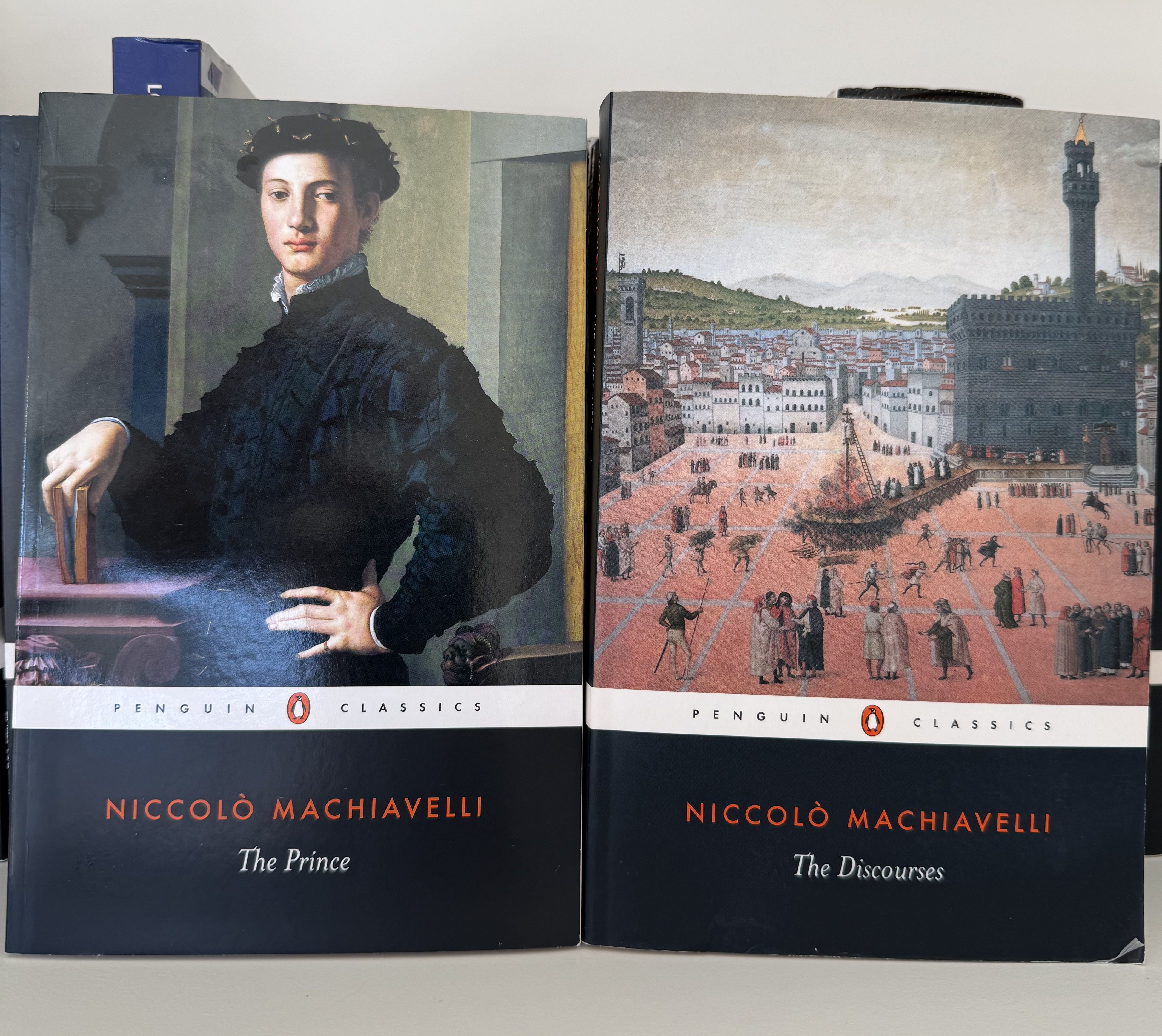
Again, I’m beginning with The Prince.
I will post more updates the closer I get.
What To Do
If you wish to join this book club reading or not, first, you must be a paid member. Go to the chat in Substack, there I have a thread in the chat called Machiavelli. If you plan to read along, reply “I’m in and will read The Prince.” If you plan to read The Discourses instead, announce that, if both books, announce that. If you’re planning to not read along but will join in on the conversation, simply reply, “I’m in.” And of course, any paid member at any time during my reading of Machiavelli can ask a question or join in.
This book club is the first of many and your participation will help shape future book clubs.
If you want in and you’re not a paid member then upgrade your membership.
Looking forward to an awesome discussion!