

July and August were chaotic months for me. The bad chaos: a crazy family situation arose for me in the middle of July, and I’ve been nonstop dealing with it. It’s required trips to Boston, and most of my time here in Colorado has been spent on the phone.
The good chaos has been watching my daughter grow. She’s now 9 months old as of this writing, and I’m having a blast. I love visiting Omaha, where my wife is from, and but now watching my daughter with her in-laws and cousins is a joy. I love Omaha, as I said, and I put a deposit on land there. Colorado is hell-bent on committing suicide, and now, having a family, an innate itch to move closer to family won’t go away. I recently got back from seeing my family in Maine. Again, seeing my daughter with her second cousins on my side of the family, and my aunt and uncle somewhat becoming grandparents to her, is touching to say the least. My dad passed away in 2008, and my mom is pretty sick. For a while I believed my children would not quite get the grandparent experience from my side of the family. But having my aunt and uncle emerge as those figures is a blessing.
Chaos can make finding time to read challenging. Lately, flying is where I get in the most reading. Chaos also makes it tricky with focus and easy to forget what you’ve read. I looked at my last recap article and forgot I read those books. I remember the stories and topics, but life threw a lot onto my lap. Savoring those books in any manner went out the window.
It’s easy to get discouraged when life throws curveballs and interrupts reading. It’s natural. No one says you can’t start a book over. It’s not a law to finish a book by a specific timeline. If you know some chaos is happening or about to happen, and you’re looking for what to read next, you can pick easy beach reads if you want. And it’s ok to read in small sips. It might take a long time, but who cares? Do what works for you, and if it’s small sips or guilty-pleasure reads or maybe a small break, there’s nothing wrong with it.
Currently, the topic for my book club is America. I curated big books for it:
The Last King of America: The Misunderstood Reign of King George III, Andrew Roberts
A Patriot’s History of the United States: From Columbus’s Great Discovery to America’s Age of Entitlement + The Patriot’s History Reader: Essential Documents for Every American, Larry Schweikart and Michael Allen
A History of the American People, Paul Johnson
Democracy in America, Alexis de Tocqueville (And I’ll read Pierre Manent’s book on Tocqueville, Tocqueville and the Nature of Democracy, as a primer)
Ethnic America, Thomas Sowell
I finished The Last King of America, and that was a behemoth of a book. I’ll give a brief recap below, but after finishing I needed a break and some easier reads before jumping into the next book, A Patriot’s History of the United States, which I’m currently reading. The next one I’ll read for the America topic will be the iconic A History of the American People by Paul Johnson. I have no idea yet when I’ll start it, as I know I’ll need a breather after A Patriot’s History. But I’ll keep you informed.
The next book club topic might be a dive into Catholicism. I’m floating that around in my head. As I mentioned before, it’s likely I’ll start it alongside the America topic since the America topic has some big books and will require some breaks.
If you’re reading books for a topic, sometimes you feel motivated to carry on, and other times you feel a break is needed. For the latter, an easy tell is if you love the book, but toward the latter half you’re getting that “I need to finish this” sensation. And that somehow manifests, for me anyway, as either rushing or putting off reading it a bit. And it’s not because the book is boring me, that does happen, but in this case, it’s the weight of everything thrown at me. When I noticed that sensation toward the latter half of The Last King of America I knew I would need a quick and easy break to feel fresh for the next book curated for the topic. Sometimes a break is not needed. Why? A multitude of reasons, from motivation to the nature of the next book.
Regardless, it’s ok to take that break.
This recap is what I read on that break, plus Last King and something different as you’ll see below.
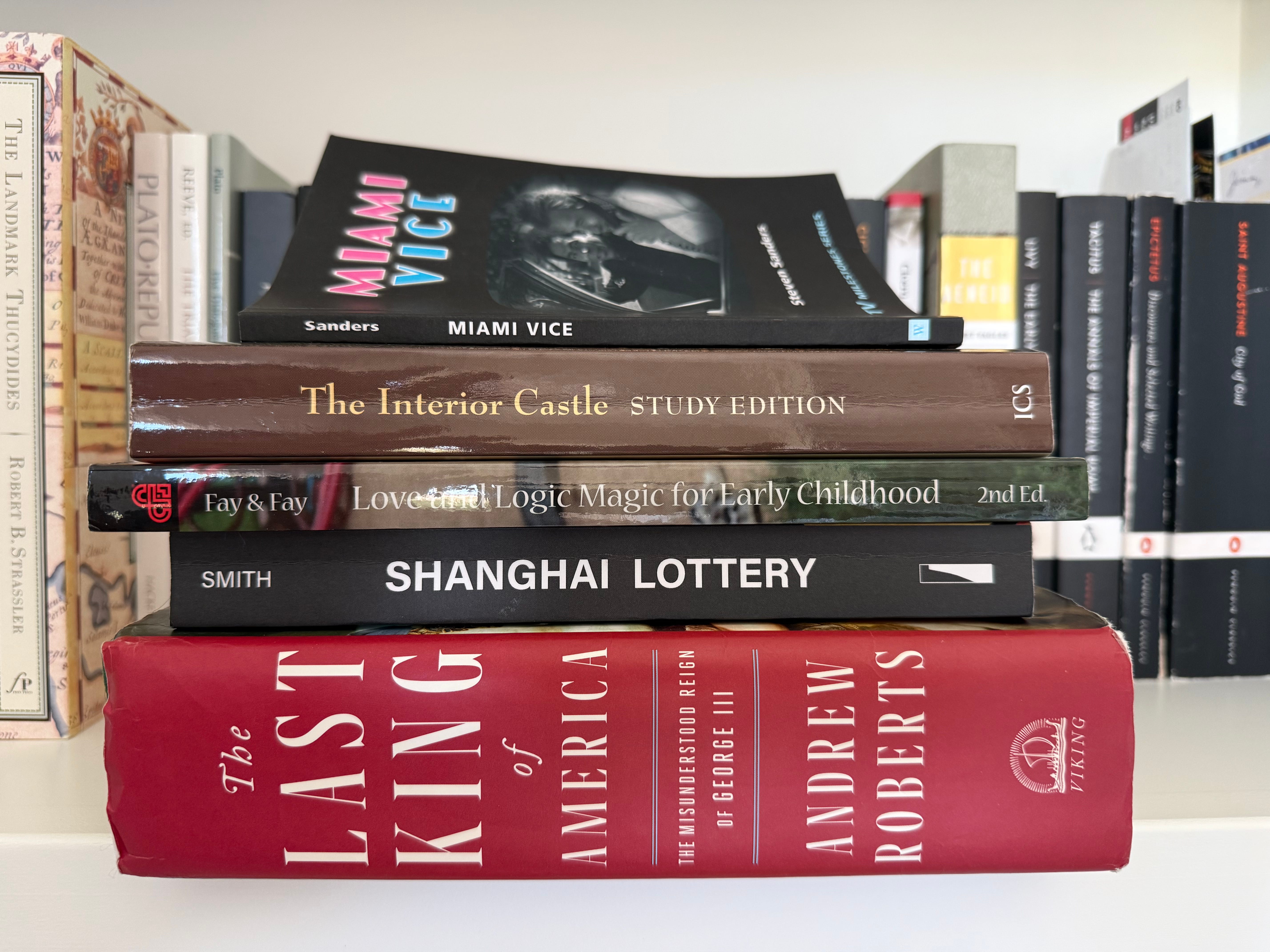
The Last King of America: The Misunderstood Reign of George III, Andrew Roberts
King George III is thought of by most with a passing knowledge of America’s founding as a tyrant, and from the English viewpoint that he was inept and stupid.
Both sentiments are untrue. Deeply untrue. Flat out wrong, in fact.
Andrew Roberts is a Hoover Fellow historian, noted for his famous biographies of Winston Churchill and Napoleon. He’s exhaustive with evidence. And with King George III, Roberts was one of the first to see the unreleased archives of George III by Queen Elizabeth. Those archives contain over 300,000 pages of letters, diary entries, George’s grades, his inner circle’s correspondence with him or about him from that time, and more. The massive archive validates George III. He was not tyrannical. He was not dumb.
George III was an admirable monarch. His Achilles’ heel with America was a mixture of his idealism and his stubbornness. George wished to be above political parties, and took it as his duty to rule in that manner. Yet this overlooked human nature, and his idealism and stubborn adherence to this view didn’t pan out with America. He wouldn’t let his prime minister resign when that prime minister knew he was in over his head with America. And seeing how George faced slander from his grandfather as soon as he was born, slander that fomented most of the tropes we know of George today, he stubbornly stuck with certain people and rejected those who were associated in any manner to that slander. This didn’t work policy-wise with America. But those qualities that failed in America yielded the opposite when Napoleon came along. George seemed the lone world leader capable enough to handle Napoleon.
Roberts paints a detailed picture of George, the period he lived in, and the stresses of a world changing so rapidly. And that George suffered from bouts of mental illness and was plagued by the behaviors of progeny and nieces and nephews who acted terribly: a profligate son, a lascivious niece, among others. It all added enormous stress on him, as it would to anybody.
The best-known part of the biography, however, isn’t George III. It’s Roberts’s step-by-step analytical walkthrough of the Declaration of Independence. What made this section notorious and debated among historians is Roberts’s counter to the claims made in the Declaration. The counter reveals the power behind the Declaration, how and why it was written in the way it was written, the spirit of America, and why George and Britons were so confused by it. The latter, simply: Jefferson was a fabulist with some claims. He rhetorically used hyperbole and fabulism for a specific purpose: Americans liked the King. The real issue was with Parliament, yet for independence to happen Jefferson and the authors knew they had to cast off the King. And Jefferson aimed his rhetoric to whip up a frenzy and to get those sitting on the fence about American independence to come into the fold. When British Parliament and the King saw the document, they were flabbergasted at the claims. It’s common today to hear that those signing it could have been hanged for treason. Well, that’s part of the hyperbole. Neither the King nor Parliament would have sought that action. They were both working hard to keep America and were not seeking to punish. And the claims were so outlandish that they were trying to figure out what it meant. It’s a fascinating section of the book. It’s worth buying the book just to check that out alone.
The Last King of America is weighty, weighty in its biography of George III, and weighty in its history of George’s era. It requires a motivated reader. George III is not as sexy as Winston Churchill or Napoleon Bonaparte or World War II, all of which Roberts has covered. But the period of George III — American Revolution and Napoleon — is fascinating. And Roberts has a knack for showing the timely comparisons or historical rhymes we see today. Even just the stress of being a world leader, Roberts depicts. Books like this require a motivated reader for the topic, but if you find yourself motivated on America’s founding, Napoleon, and everything surrounding that period, The Last King of America is an excellent choice.
Shanghai Lottery, Shawn T. Smith
Shawn is a good friend of mine, and this is his debut novel. Shawn is a psychologist and thought leader on masculinity and relationships. He’s written a few books on dating such as The Tactical Guide to Women, The Practical Guide to Men, and Gatekeeper (I can’t speak to the one on women, but every man should read Practical Guide to Men, and Gatekeeper.)
Debut novels are tough. Even for the big-name authors you know, a debut novel can struggle. I’ve been given some debut novels and they’re unreadable. The ones I was given followed a story coach or a story formula. As either sells the magical promise of how to write a successful novel. But those formulas and coaches have the habit of making the story abysmal and trite. Add in poor writing, and it’s unreadable.
Shawn’s novel proved a page-turner. He finds his confidence a few pages in, and the story takes off. What makes the story, aside from memorable characters and a story where you want to know what happens next, is Shawn’s depth of psychological wisdom. It’s a pragmatic depth and from experience. Here and there in the novel, Shawn will drop a nugget of psychological wisdom.
A normal life has inconveniences. An alcoholic’s life has extremely urgent urgencies that spill into other people’s affairs.
Tammy always hides her troubles as long as possible, and she picks men who lack the curiosity to notice them.
On social media, accusations carry more weight than a federal conviction.
And many more exist in the pages. But what adds enjoyment to the nuggets is that they work with the story. They’re painted into the details. And the story is of a young man lacking self-confidence, yet he’s conscientious. He has a famous anon social media account, and this double life — more wisdom again — the choices he makes with it play out with consequences and trade-offs. He must step into a ring, into a Roman gladiator mob mentality of wanting sacrifice, and defend his and his woman’s honor. Alongside that narrative, a love story evolves.
The love story is refreshing. Refreshing in that it’s real. It’s not some sappy romance. Nor is it plagued with the jaded sophomoric pseudo-theories deluged online. Instead we get something real. We get a real version of a woman seeing a man’s potential, and that potential is not linked to becoming the richest or hottest man on the planet. And we see man waiting to see if the shoe will drop yet also noticing a bit of her fear with conflict.
I found myself wanting to get to the next page faster because, like any good story, I wanted to know what happened next. It’s a fun read with lots of wisdom buried in it. It’s a great debut novel.
Love and Logic Magic for Early Childhood: Practical Parenting from Birth to Six Years, Jim Fay & Charles Fay, Ph.D.
As of this writing my daughter is 9 months old. We’re not yet at the discipline stage, yet it’s around the corner. I discovered Love and Logic from a good friend. That friend is the author mentioned above, and another friend of mine was raised by it, and a good friend of my wife raised her daughters with it. I’m learning that parenting is intuitive most of the time, but moments arise when it’s “ok, what am I gonna do here?” and some guidance and wisdom helps.
I’ll be judgmental, it’s my kid, and I see a lot of what I don’t want to do when I see other parents. I resonate and observe the parents that have the great kids at all ages. I discard parents who say the “terrible twos” are real or will just happen, or who have kids who fold at any stress or hold the parents hostage by needing entertainment every second, or what drives me nuts the most, the modern therapy-culture helicopter-style parents.
The style of parenting I resonate with is authoritative, not disciplinarian, not gentle parenting, or not kid-led. Authoritative here, to define it so people don’t leap to “authoritarian,” means loving and firm; a consultant versus a drill sergeant or some therapy-culture nanny-state dad.
As I witness the parenting style that speaks to me, and what comes naturally to me, and much along the lines of how my dad fathered, Love and Logic complements it. I don’t see it as a script or a formula I must follow, but I see the guidelines. And the big thing is, as a parent you don’t want to see your kid struggle. Also, sometimes, since you’re an adult, you know how to solve a problem and want to solve it for them. But that impulse needs checking, as you have to let kids figure things out and even make mistakes. Love and Logic provides a great guideline for that, and a guideline to lead with true empathy: “That stinks, kid.” but then follow that with guidance on how to let them figure out their issue, and offer some help if they ask, “How do you think you’re gonna handle it?” If need be “Would you like some ideas / Here’s how some do it.” And sometimes you pull the rip chord and take the lead to let them know a boundary or standard exists.
If you’re a parent and want some excellent wisdom on parenting that is pragmatic and easy, and makes sense when you read it, Love and Logic is a good place to check out.
The Interior Castle, St. Teresa of Avila
I began a recap here and I wrote over 3,000 words. I’m going to turn it into an essay. But I will leave you with this: it’s a famous work of the Catholic canon. It’s beautiful and inspiring. Make sure to get the version translated and prepared by Kieran Kavanaugh, O.C.D. Interior Castle is repetitive, incredibly repetitive at times, but the Study Edition by Kavanaugh makes it much easier to go through, and when it gets too repetitive, you can follow his guidance to get to the point.
The Mirabai Starr version, the version you’re most likely to come across in a bookstore or on Amazon, is a Bowdlerized translation. The back jacket states, “Free of religious dogma,” and Starr turns it more or less into how Starr would envision the work for a New Age audience. Avoid this version.
The essay on this piece is coming soon.
Miami Vice: Seasons 1 & 2
Yes, the iconic 1980s television show. Not a book.
I slowly rewatched the first two seasons of the series. I’ve seen all seasons, but it had been a long time since I watched it. I intentionally wanted to rewatch seasons 1 and 2 after taking my wife through The Sopranos for her first time. The rewatch began over a year ago.
A trope surrounds Miami Vice, and this trope perpetuates a myth recycled by people who have never ever watched the show: Miami Vice was simply “MTV Cops.” A few people see it as cheesy fashion, cheesy stories, and so forth. Again, people claiming this view have never ever seen it, but to sound sophisticated and original recycle what they’ve heard.
Miami Vice is an iconic show. It was revolutionary with its soundtrack and scoring, and it helped revitalize Miami. And the show holds up in time. Sure, some of the storylines and effects are on-the-nose 1980s television. Yet one must keep in mind, shows on HBO, which had more leeway to go into grittier topics and themes, like The Sopranos or Game of Thrones, were not a thing in the 1980s. Miami Vice first aired in September of 1984. Network television still had strict rules. Most cop shows of the time had basic plots of good guy always catches bad guy. When Miami Vice aired, the show was wild. The popular music coinciding with Jan Hammer composing scores was unlike anything done before in television, and in many ways, even movies.
The flash of the show, the fashion, the aesthetic, broke boundaries and remain timeless. But while the fashion and the music are well-remembered, what’s often overlooked are the excellent storylines, the performances, and the accurate portrayal of a masculine bond.
Raymond Chandler took the hard-boiled detective story to sonic heights. His novels and his screenwriting fomented the Hollywood noir genre. Miami Vice is distinctly Miami noir and stands on its own. It’s original. It’s groundbreaking. It’s iconic. The pastels mixed with dark themes, and the brilliance of Michael Mann’s filming, what he captures, is noir on a sonic level.
Don Johnson and Philip Michael Thomas are the main stars of the show. Yet what I noticed on this rewatch was the masculine bond. Most Hollywood depictions of men lack the masculine bond. Even iconic movies, you don’t sense an accurate bond. A masculine bond is a kind of ideal between two men. They know each other’s weaknesses and strengths, and can almost read the other. They have each other’s backs, but never do a kind of “lecture” or inspirational speech to each other. That’s more reserved for mentor and mentee. They bust each other’s balls, and the disposition of each balances out the other. For instance, Don Johnson’s character, Sonny, can get neurotically obsessed with something, whether a woman or a bad guy, and his stubbornness can put the blinders on. Philip Michael Thomas’s character, Ricardo Tubbs, recognizes this and recognizes how to handle it. He handles it subtly, in a way that maintains Sonny’s respect, and in fact puts more trust into that respect. Tubbs is a more sensitive man, a man of passion. His sensitivity is a double-edged sword. He gets drawn in. It brings out his sense of justice and determination, yet he can get himself too deep. Sonny provides the blunt aggression to get Tubbs out of a mess. And aside from the action, the general conversation of the two, it’s an excellent example of masculinity and the masculine bond.
The show is a cop show, but the good guys don’t always win. Not every episode offers a clean and neat ending. It has messy endings, as real life has messy endings. Each character has to face the reality of criminals and their consequences, and their struggle to not get overly cynical due to what they face on a daily basis. The themes of suicide, murder, incest, rape, cons, the dark side of excess, and more all play out in the show.
Miami Vice holds up. Seasons 3–5, Miami Vice takes a different turn. Michael Mann leaves after season 2, and with him goes that Miami feel of the show, and it feels more like a standard cop show. The big thing you notice, the pastels are gone and it’s all earth tones aside from the iconic white Ferrari Testarossa. (For me, the black Daytona, which was a fake Daytona, it was a body kit they used to make it look like the real thing, looked cooler.) The writing is still good in those seasons, yet some episodes jump the shark, like the weird Cows of October episode or the amnesia storyline of Sonny. In my opinion, seasons 1 and 2 are the best.
Thanks, Jim! This made my day.
Hi Jim,
I’m in a similar stage of life as you, with a 7 week old at home and considering a move out of Colorado to be closer to family. On your recommendation, I read The Happiest Baby on the Block and Raising Mentally Strong Kids.
Following the guidance in the former, we had no issues with colic - or purple crying as I’ve learned is the new term for it. It was a bit repetitive but its guidance worked. The latter deeply resonated with me, it’s the kind of book where you quickly realize it has re-read value because the author can articulate challenges you’ve seen but haven’t had the words for. I also like that it offered pragmatic guidelines without being overly prescriptive.
I recently read Leaving a Legacy by Johann Kurtz which offered counterintuitive guidance on the role of wealth in the world of parenting. Thinking it’s something that would resonate with you as well.
All that said, your recommendations have had a positive impact on my family and me, and I’m looking forward to reading the Love and Logic book you recommend here.
If nothing else, I hope this comment helps you see the impact your newsletter has as your motivation is challenged from time to time. Cheers 🥂