

Why did the Roman Empire fall?
Are we in a decline like the Roman Empire?
Was it because of the Christians?
Did inflation cause the fall?
Did the degenerate culture cause the fall?
I heard it was the greatest culture, claims of its degeneracy are overblown, and the fall was because of something in the water lowering testosterone, is that true?
Ideological validation via the causality of the Roman Empire’s fall is the desire of someone asking those questions. One-size-fits-all theories are abound regarding the Roman Empire. People swing the Roman Empire around as a means for their ideological perspective. They abuse the history of the empire to warn of our fall. People rehash positions — many long debunked — of why the Empire fell, or argue of its sterling virtues and how some factor like lowered testosterone ruined it, or argue of its extreme lechery as a reason for its fall. Crypto bros, cultural moralizers, alt-right Nietzschean vitalists, Marxist Materialists, combative secularists, preachy Christians, among others, all abuse the Roman Empire for their ideological moralizing.
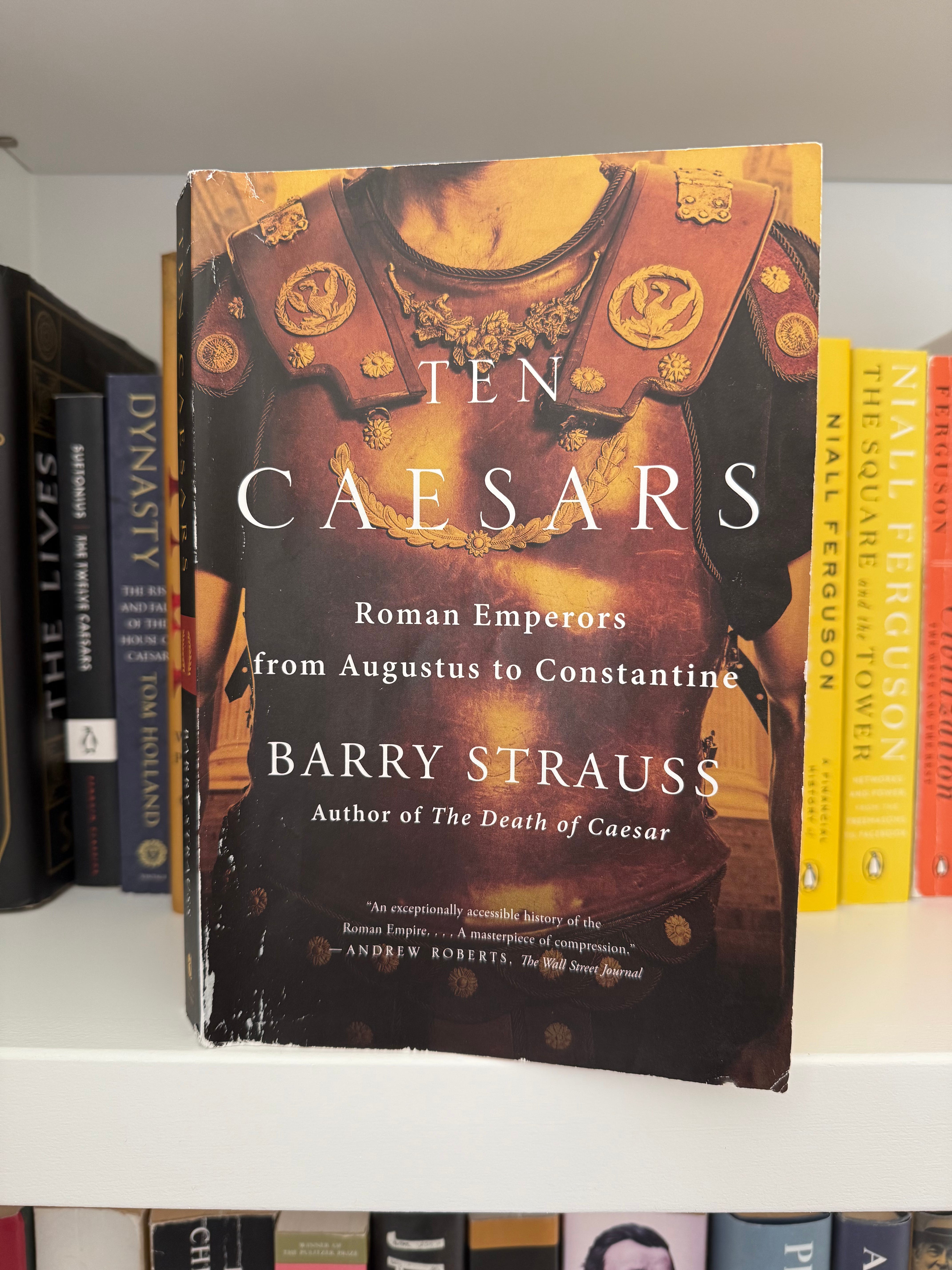
Finding clarity amongst the racket is challenging. Barry Strauss’s Ten Caesars does provide clarity, succinctness, and nuance to the massive and complex Roman Empire. Barry Strauss is a Hoover Fellow and famed historian of the Roman Empire. His other works include The War That Made the Roman Empire and Jews vs. Rome (read review here). Strauss accomplishes a remarkable feat by making the Roman Empire, from politics, war, to culture, accessible while remaining substantive in the Ten Caesars. The book comprises ten biographical vignettes. Each vignette goes far beyond the biography of the emperors analyzed; Strauss details political norms, social norms, and the cultural norms of each emperor’s era. We learn why and how the Roman Empire evolved, regressed, progressed or stagnated. Strauss introduces us to the power players of the Roman Empire, the power brokers who gave rise to emperors, and those who held enormous power and influence behind the scenes. Many power brokers of the Roman Empire were women, the mothers, wives, sisters, of emperors. Strauss gives us both a window and clarification onto the Roman Empire. He clarifies modern misconceptions and long debunked theses still taken as truth today, such as specific theses of famous figures like Edward Gibbon.
Modern Day Suetonius But Far Better And Far More Accurate
The ten vignettes are ordered chronologically. The entire timeline reveals how the empire evolved, regressed, and stagnated. With each vignette we get a clear, and sometimes myth busting, sometimes sobering, look into the empire’s culture, social dynamics, and politics. Strauss covers:
Augustus
Tiberius
Nero
Vespasian
Trajan
Hadrian
Marcus Aurelius
Septimius Severus
Diocletian
Constantine
In each we learn the rise of each emperor, how they came to be emperor, and who or what led to their ascendancy. That who or what provides concrete looks at the culture of the Roman Empire. We see the schizophrenic and perplexing marriage dynamics of the time. For instance, some women were married to their uncle, either related or not related other than by marriage, and vice versa, some nephews were wedded to their aunts, some stepsons, or stepdaughters, married to their stepfather or stepmothers. The custom was to marry for political or social station. Yet, as Strauss shows, certain women were sought after, and some emperors were fortunate to have arranged marriages with them because these women injected political force into the ruling legacy. These women were intelligent, cunning, Machiavellian, and resourceful. They could play the game of Roman politics and Roman statecraft and play it masterfully.
Strauss expounds the political styles of each emperor, and the dynamics of the period the emperor ascended and ruled, in other words the context and realities of their rule, what led to it, and what resulted after. The context and realities, under Strauss’s wise guidance, paint the reality of Roman culture giving a window upon each period.
Clarification
Modern theories, claims, and “takes” surround the Roman Empire, especially on a platform like X. The most common style: a neurotic focus on modern culture steered through the lens of a personal ideology and the required elimination or correction of particular ills in our modern culture to obtain the ideology’s promised societal utopia, and brandishing theories apropos to the Roman Empire, glibly or conspiratorially, as a form of argument to validate their personal ideology. In other words, cast the blame for the fall on a single cause, and that single cause being a personal gripe with modern society, bonus points for moralizing or outright repudiation of modern society. For instance, bikinis caused the fall of the Roman Empire, and since we have bikinis now, therefore the fall is near. Or that when the Roman Empire went Christian it instantly, with magic trick speed, imploded.1 The theories are unreflective and silly. If bikinis—or something else as silly—caused the fall of the Roman Empire, how could that Empire achieve complete power and domination for so long harboring the innate capacity of a sophomoric weakness that could wreck it all?
The popular “it was the Christians!” theory is directly or secondhand inspired by arguably one of the most iconic works in the Western canon, The History of the Decline and Fall of the Roman Empire by Edward Gibbon. A work abused by those who have never read it, much less even added it to their Amazon books-to-buy shopping list, and the trite “Read Gibbon” retort commonly found on social media betrays the abuser.
The comparison theories stem from gripes with modern culture. Strauss clears the air on the popular salacious rumors of Roman Empire cultural degeneracy, which also clears the air on the culture. Indeed, the Roman Empire’s culture did feature excess, vanity, and lechery. Yet, in some aspects not to the extent claimed today, nor was it some Hallmark version of the Victorian Era hoisted upon the Roman Empire as some pseudo-Roman Empire revisionists wish to portray. Whether certain emperors indulged to the point claimed in ancient sources requires nuance and the eye of an expert like Strauss. Generally, certain historical sources written from political or social agendas would either embroider salacious rumors about an emperor to diminish him or to make that past emperor appalling and the current emperor the savior. The sex lives of famous Roman women were a popular salacious rumor to leverage in the Roman Empire, as they are today. The reality is, yes, lechery was a feature of the Roman Empire, for both men and women. With couples, marriage dynamics, as stated, were schizophrenic, baffling, and ennui inducing. Misogyny was rife in the Roman Empire, and powerful women faced the brunt of the salacious rumors. Those conflating today’s promiscuity (which is not as rampant as claimed by certain groups) to the Roman Empire’s promiscuity make the mistake of viewing the Roman Empire through the relationship and dating norms of the modern West. The feasible comparison is not so much a comparison, rather it’s a reflection on human nature: a culture of transgression feeds personal and cultural apathy. We humans are always capable of transgression, it’s innate to us and the transgression is not always a result from the influence of the current thing in popular culture. Strauss clarifies the mistaken conflations and carefully guides us to the likely realities.
Such as this from Suetonius on Tiberius:
Following his retirement to Capri, he set up a brothel where he could devote himself in private to sexual activities, and in these he would watch troops of girls recruited from far and wide, male prostitutes in the full bloom of adulthood, and children whose particular talent was for fucking and getting fucked at the same time (’sphincters’, he called them) all joining together in an orgy of threesomes: a spectacle sufficiently obscene to excite his flagging libido. … He set up shrines to Venus in woods and groves across Capri, where young boys dressed as Pan and girls dress as nymphs would solicit sex outside caves and grottoes: because of this people openly made play with the island’s name, calling it ‘Goat Park’.
Strauss clarifies:
The historian Suetonius is full of juicy stories about Tiberius’s sexual misdeeds on the island. The “old goat,” as people are said to have called him, supposedly went after women as well as children of both sexes. His debaucheries are said to have included orgies, threesomes, pedophilia, and the murder of someone who refused him. He supposedly trained little boys to chase him when he was swimming and to get between his legs and lick and nibble him — he called them his “minnows.” Reports like this may have contributed to Tiberius’s low public standing in Rome, but Roman history is full of salacious rumors, and we should be skeptical. In reality, stargazing and fortune-telling are probably as risqué as Tiberius got on the island.
Turning to the Christian theory, Strauss shatters the theory that when the empire went Christian it fell:
Gibbon suggested long ago that Christianity played a big role in the fall of Rome because it sapped the fighting spirit of its people. This is nonsense. The eastern half of the Roman empire was more passionately Christian than the west, and it did not fall in 476. In fact, it remained as an empire for another 150 years, until the Islamic conquest of most of it. Afterward, it survived as a regional power for another 800 years, finally coming to an end only in 1453, nearly 1000 years after the fall of the West. Nor did Christianity stop European states from fighting one another and conquering much of the world for the better part of two millennia.
Still, an argument laments the loss of Rome and the West, and that argument implies that Christians caused the fall and loss of Rome. The argument is nostalgic lamenting over a loss of their personal fantasy of Rome. A basic, economic truth is that society, and all it encompasses, flows towards dynamic areas. An oversimplified saying of this: money goes where money is welcomed. But it’s not just money, it’s social and cultural dynamism that allures. New York City attracts people from all over the world to experience the various and variegated possibilities on offer. The business, culture, arts, fashions, all attract people to New York City, and New York City is often at the leading edge of those elements. The same can be said of Los Angeles. And in today’s era, cities like Miami (or heck, the state of Florida) are now luring people with its dynamism. The eastern part of the Roman Empire was the most cultured and the most dynamic. From Caesar onward, each emperor had eyes on the east. The Western part of the empire was more or less a cultural backwater that had to be dealt with. Rome was the only great city as dynamism in Germany, France, or England was nonexistent. The east heavily influenced the Roman Empire, Greece and past Greek cultures had a heavy sway over Rome, exemplified by the wide influence of Stoicism in the Roman Empire.
As Walter Scheidel articulates in his superb Escape from Rome:
It is therefore misleading to identify “Western Christianity” as an ultimate cause of Europe’s fragmentation: its path was secondary to outcomes in state formation. While Christianity undoubtedly contributed to post Roman polycentrism, it was above all the antecedent weakening of centralized Roman political authority that allowed and, indeed, encouraged it to do so.
Well before Christianity held any sway or even made a blip in the Roman Empire, eyes were on the East. Dynamism in the West sprang from the fall of Rome in the west and Christianity’s influence over European polycentrism.
So no, Christians did not cause the fall of the Roman Empire. Christians begat a much greater legacy: dynamism of the modern West, the science, culture, values, economics, everything that made the modern West the greatest culture in human history.
Edward Gibbon
Edward Gibbon’s The History of the Decline and Fall of the Roman Empire is a critical work in the Western canon. It’s included amongst the Great Books for good reason. Gibbon’s prose is otherworldly and the work is a masterpiece of historical writing. Gibbon is still iconic. If you go on social media, X or Substack, it looks like everyone has read Gibbon. Yet if one reads Gibbon it’s fast apparent the people on social media have not read Gibbon.
Gibbon’s theses still dominate the modern discourse surrounding the Roman Empire. Strauss mentions Gibbon a total of four times in this work. Gibbon does not dominate Ten Caesars, yet is mentioned with gravity. Strauss does not denigrate Gibbon or Gibbon’s work. It’s clear Strauss regards the work as a masterpiece, rightly so. Yet Strauss sheds light on Gibbon’s flaws. A key flaw most people are unaware of is that for a number of generations now some of Gibbon’s positions and claims have been debunked empirically. Strauss bluntly points out the driving flaw of Gibbon.
Gibbon was a snob, writing in the age of Enlightenment, with little sympathy for upstarts and outsiders.
Gibbon’s snobbery was targeted at Christians. Gibbon claimed Christianity weakened the will of Roman men, as if it were the OnlyFans of the day, isolating men in their bedrooms. Gibbon made fabulist claims of droves of men and women going into Christian monasteries to live a comfortable life, checking out of the Roman Empire, which emptied the empire of its strong citizens. Records show this claim as pure nonsense. For the claim to have been true, the monasteries would have been the size of cities, no such monastery existed at that size, and the amount of monasteries was minuscule. Again, Gibbon does give us a rigorous history but he has his flaws. And archaeological evidence and firsthand resources kept emerging and still emerge long after Gibbon’s death that prove his Christianity caused the fall thesis as false.
What Caused the Decline and Fall?
Today people take something going on in our culture, see a similarity in the Roman Empire, even if it’s a stretch, and peg it as the reason for the fall. As mentioned, degeneracy is the common blame. Absolutely, a culture rife with ennui, nihilism, cynicism, and obsession with the objectification spectrum of sex, is not good. It points to issues in the culture from boredom to stagnation, but most simply, it points to cultural decadence. Often tied to these issues, or upstream of them, is a lowering of decorum. And despite manosphere moralizations of women wearing something risqué at the airport, we need to zoom out from the one attractive woman dressing provocatively, and look at the majority of the population. A lowering of decorum is clear when behavior and dress is considered, and it isn’t always risqué dress. Returning to the airport, consider grown men walking around in pajamas, people who cut their toenails on the plane, the more common fat women wearing the same tight yoga pants of that attractive woman complained about by the manosphere, which highlight her aesthetic defects as she jiggles around the airport. This lowering of decorum is a loss of understanding, care, respect, and tact for standards. But something like widespread lechery does not cause a civilization to fall, it might be indicative of a culture in trouble, but it’s not the cause of the fall, in fact it barely has any role in a fall. Culture is downstream of politics. It’s downstream of institutions. Certainly the Roman Empire’s culture had issues and a rotting culture at various periods. The rotting culture didn’t help the Empire, but the Empire ebbed and flowed, it looked gone at times but Diocletian and Constantine brought it back from the brink and made it robust.
So What Caused The Fall?
Strauss answers:
The Roman Empire in the West fell because of bad leadership as well as poorly deployed military resources, internal division, strong enemies, unfavorable geography, and a decline of resources. The empire would have other great leaders before the West fell, but most of them would be in the East.
That’s Strauss’s summary in the epilogue of the Ten Caesars. The context is all over the book. Those reasons are not as sexy as blaming bikinis or the Christians or lead in the water lowering testosterone or cryptocurrency bros’ claims. Most people lack knowledge on deployed military resources, or what is the context behind the decline of resources, or topics like economic inelasticity. When that discussion happens eyes glaze over. It’s much easier for someone who dislikes modern sensibilities, or rather, the trend of women’s current bikini fashion to include thongs, to decry it and wield the Roman Empire as their argument versus enumerating and dissecting the decline of resources effect on an inelastic economy. And for the concept of modern enemies, it’s easier to go conspiratorial like Nick Fuentes and blame the Jews or marriage, instead of going into the intricacies of foreign policy and foreign statecraft. Which is why the impatient, the unprincipled, the unserious, and the dummies will stew over topics like Jews, Christians, and bikinis as the catalyst for the fall.
Who Would Like It & Why Read It
Strauss is a compelling writer. He’s accessible and rigorous. His other works, The War That Made The Roman Empire and Jews vs. Rome complement Ten Caesars well. One can read them all with this, yet Ten Caesars stands alone. It delivers an encompassing look and understanding of the Roman Empire.
If you have any interest in the Roman Empire, then this is a superb work. Whether you want to just read one book on it, or kick off reading a few books on it, you will not go wrong starting with Ten Caesars.

